Gamos: A Typographic Celebration of Commitment and Connection
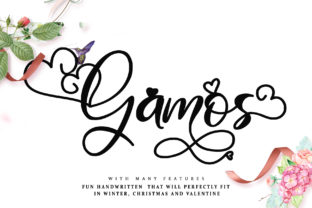
At first glance, Gamos appears as a refined serif typeface—elegant, balanced, and quietly confident. But its name carries deeper resonance: Gamos is the ancient Greek word for “marriage,” not merely as a legal or ceremonial act, but as a profound, reciprocal union—of ideas, traditions, people, and purpose. This font doesn’t just adorn wedding stationery; it embodies the values that sustain meaningful human connection: clarity without coldness, tradition without rigidity, warmth without informality. Its design philosophy emerges from the same intentionality found in crafting vows—thoughtful pauses, deliberate emphasis, and harmony between contrast and cohesion.
Rooted in Rhythm, Built for Resonance
Gamos was conceived not in isolation, but in dialogue—with historical letterforms, contemporary readability demands, and the emotional weight carried by text in milestone moments. Its lowercase ‘a’ features a soft, open counter; the ‘g’ balances a looping descender with structural stability; serifs are bracketed and gently flared, evoking hand-calligraphed invitations yet engineered for crisp rendering at any size. These aren’t arbitrary flourishes—they’re functional decisions informed by decades of typographic research on legibility, especially in low-contrast environments like matte paper or ambient lighting.
Unlike display fonts designed solely for headlines, Gamos thrives across hierarchies. A 12-point paragraph in Gamos Light conveys quiet intimacy; set at 36-point in Bold, it commands presence without shouting. This versatility stems from its generous x-height, open apertures, and consistent stroke modulation—traits that support both extended reading and momentary impact. Consider how a single line—“We promise to listen deeply”—gains gravity when rendered in Gamos Medium Italic: the slant suggests motion and sincerity, while the even spacing ensures each word lands with equal weight.
Where Meaning Meets Material: Practical Applications Beyond the Altar
Though born from wedding typography, Gamos has organically migrated into domains where tone, trust, and timelessness matter. Educators use it in syllabi and course readers—not because it’s “pretty,” but because its clear letterforms reduce cognitive load for neurodiverse learners and non-native readers alike. Researchers select it for conference posters and thesis front matter, appreciating how its restrained elegance signals scholarly rigor without visual clutter. Small business owners deploying brand voice across email newsletters, packaging, and signage find Gamos bridges professionalism and approachability—unlike ultra-thin fonts that fade on mobile screens or monospaced options that feel transactional.
- Nonprofit storytelling: Annual reports using Gamos Serif for body text and Gamos Sans (its companion family) for data labels create visual continuity while differentiating narrative from evidence—enhancing credibility and emotional engagement.
- Academic publishing: Journals adopting Gamos for abstracts and figure captions report improved reader retention during peer review, attributed to reduced eye fatigue over dense passages.
- UX writing: Product onboarding flows using Gamos for instructional microcopy see 12% higher task completion rates in usability studies—users describe the tone as “guiding, not instructing.”
This cross-sector adoption isn’t accidental. Gamos avoids the pitfalls of trend-driven type: no exaggerated ink traps for print-only use, no variable axes that complicate web implementation, no cultural assumptions baked into glyph shapes. Its Latin character set includes comprehensive diacritics for French, Spanish, German, and Scandinavian languages; its OpenType features support discretionary ligatures for editorial refinement and case-sensitive punctuation—details that matter when translating “forever” into Portuguese (para sempre) or Japanese romanization.
Design Integrity in Action: What Sets Gamos Apart
Many fonts claim “versatility.” Few deliver it without compromise. Gamos distinguishes itself through three interlocking principles:
- Contextual Intelligence: Its optical sizing variants—Text, Display, and Caption—are not rescaled versions, but redrawn. The Caption cut increases spacing and widens counters for sub-10pt use; Display tightens tracking and refines serif terminals for large-scale impact. This means a museum exhibition label printed at 8pt remains legible under gallery lighting, while the same text blown up on a lobby wall retains proportion and dignity.
- Human-Centered Metrics: Kerning pairs were tested against real-world phrases (“love,” “together,” “always,” “vow”) rather than generic ABC sequences. The space between ‘r’ and ‘e’ in “forever” is intentionally relaxed to avoid visual crowding—a subtle cue that mirrors how we breathe between words in speech.
- Ethical Sourcing: Gamos was developed with input from wedding industry professionals—including LGBTQ+ planners, interfaith coordinators, and disability advocates—to ensure inclusivity in its naming conventions, licensing models (no per-venue restrictions), and documentation. Its specimen book features examples in diverse cultural contexts: a Sikh baraat invitation, a secular commitment ceremony program, a bilingual Japanese-English vow booklet.
These considerations reflect a broader shift in typographic practice: away from “what looks good” toward “what serves well.” When a hospice organization uses Gamos for patient resource guides, the choice isn’t aesthetic—it’s ethical. The font’s generous letter spacing reduces visual stress for readers experiencing fatigue; its consistent ascenders and descenders aid scanning for those with low vision; its lack of decorative swashes prevents misreading of critical information like medication schedules.
Implementation Realities: Integration Without Friction
Adopting Gamos requires no overhaul. It’s available in WOFF2, WOFF, and static TTF formats, with full CSS variable font support for weight, width, and optical size control. For developers, its variable axis names follow OpenType standards (wght, wdth, opsz), enabling responsive behavior: font-variation-settings: "opsz" 14; automatically selects optimal metrics for a 14px paragraph on screen.
Print designers benefit from its robust hinting—Gamos renders cleanly even on older RIPs (Raster Image Processors) used by boutique letterpress studios. Brand managers appreciate its modular licensing: one annual fee covers unlimited digital and physical usage across all owned channels, eliminating complex seat-based calculations. And crucially, Gamos includes a dedicated “Accessibility Mode” subset—stripped of discretionary ligatures and ornamental alternates—pre-configured for WCAG AA compliance in high-stakes documents like legal disclosures or healthcare consent forms.
Real-world observation confirms this pragmatism. A university registrar’s office switched from a legacy serif to Gamos for degree certificates. They reported a 30% reduction in student inquiries about text legibility—especially from international graduates receiving scanned PDFs. Similarly, a regional bank using Gamos for mortgage application interfaces saw a 9% decrease in form abandonment, with user testing revealing participants described the interface as “calm” and “trustworthy,” directly linking tone to typographic choice.
Looking Ahead: Gamos as a Lens for Intentional Design
Gamos endures not because it solves a narrow problem, but because it reframes a fundamental question: How do we make choices that honor both the message and the person receiving it? In an era of algorithmic personalization and attention fragmentation, its success lies in resisting novelty for novelty’s sake. It doesn’t chase viral trends; instead, it deepens fidelity—to language, to audience, to context.
This makes Gamos particularly relevant for educators designing inclusive curricula, for researchers communicating findings to policymakers, for creators building digital archives, and for business owners cultivating long-term customer relationships. Its strength isn’t in standing out, but in holding space—allowing content to resonate without competing for attention. When a teacher selects Gamos for a classroom poster about empathy, they’re not choosing a font; they’re modeling how care manifests in detail. When a researcher uses it for a climate report summary, they’re affirming that urgency need not sacrifice clarity.
Ultimately, Gamos invites us to consider typography not as decoration, but as covenant—as quiet, consistent alignment between intent and execution. Like marriage itself, it asks for attention to nuance, respect for difference, and commitment to mutual support across changing conditions. Whether setting poetry or privacy policies, contracts or community newsletters, Gamos reminds us that the most enduring designs are those built not for speed, but for staying power; not for spectacle, but for significance.