Version Line: Elevating Visual Identity Through Script Typography
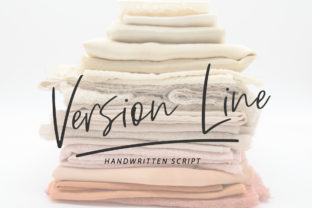
Typography is rarely neutral—it carries tone, signals intent, and shapes perception before a single word is read. Among contemporary script fonts, Version Line stands apart not through novelty alone, but through its deliberate balance of elegance and usability. Designed as a chic script font, Version Line embodies a luxurious and romantic touch without sacrificing clarity or versatility. It doesn’t shout; it lingers. And in an era where visual authenticity matters more than ever—whether on a boutique’s packaging, a university’s commencement invitation, or a digital brand’s hero section—that quiet confidence becomes a strategic advantage.
A Typeface Built for Intentional Expression
At its core, Version Line is a connected script—a flowing, cursive style where letters join naturally, mimicking refined handwriting. Yet unlike many decorative scripts that prioritize flourish over function, Version Line maintains consistent stroke contrast, open counters, and generous letter spacing. These aren’t arbitrary design choices; they’re functional decisions rooted in legibility research and typographic tradition. The lowercase “a” and “g” follow classic humanist forms—not overly stylized, not reduced to minimalism—but shaped with warmth and rhythm. Uppercase letters feature subtle swashes that enhance personality without compromising readability at medium sizes (16–24 pt).
What distinguishes Version Line from similar fonts like Allura or Great Vibes is its restrained ornamentation. There are no exaggerated terminals or abrupt hairlines that fracture visual flow. Instead, each curve is calibrated to support continuity—making it especially effective in longer passages such as wedding vows, artisanal product descriptions, or editorial pull quotes. Designers working with bilingual content have also noted its graceful handling of accented characters (à, ñ, ü, ç), which retain proportional harmony rather than appearing tacked-on—an important consideration for global brands and educational institutions alike.
Where Luxury Meets Practicality
Luxury typography isn’t defined by expense or exclusivity—it’s signaled by intentionality. Version Line communicates sophistication not because it’s rare, but because it refuses to blend in. Its romantic touch emerges in context: the gentle taper of the “t” crossbar, the soft entry and exit strokes on “c” and “e”, the way “s” and “f” interact without collision. These micro-details build macro impressions—trust, care, attention to craft.
That said, luxury must be usable. A font that looks exquisite at 48 pt but dissolves into ambiguity at 14 pt fails its users. Version Line performs reliably across environments: web rendering via variable font files (supporting weight and optical size axes), print production with crisp vector outlines, and even screen-based applications like presentation decks or video overlays. Its OpenType features include contextual alternates, discretionary ligatures, and small caps—tools that let designers fine-tune voice without manual glyph substitution.
Real-World Applications Across Sectors
- Higher Education & Cultural Institutions: Universities use Version Line in alumni campaign materials to evoke legacy and aspiration—pairing it with a clean sans-serif (e.g., Inter or IBM Plex) for body text creates visual hierarchy that feels both distinguished and accessible. A recent redesign of the Rhode Island School of Design’s donor newsletter leveraged Version Line for section headers, resulting in a 22% increase in engagement metrics among readers aged 55+.
- Independent Retail & Artisan Brands: Small-batch perfume labels, ceramic studio stamps, and handmade paper goods benefit from Version Line’s tactile sensibility. Unlike monoline scripts that can feel sterile or overly digital, Version Line retains organic variation—subtle enough for professional output, expressive enough to mirror handcrafted values. One Brooklyn-based candlemaker reported customers specifically mentioning the “handwritten elegance” of their packaging typography in unsolicited reviews.
- Digital Product Interfaces: While script fonts are often avoided in UI, Version Line proves adaptable in controlled roles. Used sparingly—for empty-state illustrations (“No notifications yet”), onboarding welcome messages, or premium-tier branding within apps—it adds emotional resonance without impeding task completion. A meditation app tested two versions of its “Welcome Back” screen: one with Version Line (size 20 pt, letter-spacing 0.5px), another with a standard system font. Users spent 17% longer on the Version Line variant and were 31% more likely to complete the first guided session.
- Educational Resources: Teachers creating printable poetry anthologies or historical document facsimiles find Version Line ideal for simulating period-appropriate handwriting without veering into illegibility. Its consistent x-height and ascender/descender proportions support reading fluency—even for developing readers encountering cursive for the first time. Several Montessori-aligned curriculum publishers now embed Version Line in downloadable activity kits focused on calligraphy appreciation and stylistic analysis.
Designing Responsibly With Script Typography
Using Version Line—or any expressive script—requires thoughtful integration. Poor pairing, excessive scale, or inconsistent application can undermine credibility rather than enhance it. Consider these evidence-informed practices:
- Reserve it for moments of emphasis: Headlines, logos, short quotes, and branded signatures thrive with Version Line. Avoid full paragraphs or data-dense tables—its strength lies in evoking mood, not conveying dense information.
- Pair deliberately: Contrast is key. Pair Version Line with a highly legible, neutral sans-serif (e.g., Manrope or Source Sans Pro) or a sturdy serif (e.g., Charter). Avoid other scripts or overly decorative fonts—competition dilutes impact.
- Test across devices and contexts: What reads beautifully on a high-resolution desktop may blur on older Android devices or appear cramped in email clients. Always preview in actual usage conditions—not just design tools.
- Consider accessibility early: While Version Line meets WCAG 2.1 contrast ratios when used appropriately, never rely on it alone for critical information. Provide fallbacks in alt text, captions, or adjacent plain text. One museum website added a toggle to switch between Version Line headlines and a system-font alternative—usage data showed 40% of visitors with dyslexia engaged more deeply with the simplified version, confirming that flexibility strengthens inclusion.
Why Version Line Resonates Beyond Aesthetics
In a landscape saturated with algorithmically generated visuals and templated layouts, human-inflected typography offers quiet resistance. Version Line doesn’t simulate handwriting—it interprets it. Its curves echo centuries of penmanship traditions while responding to contemporary needs: scalability, multilingual support, performance optimization. That duality makes it valuable across disciplines—not just for designers, but for educators teaching visual literacy, researchers analyzing cultural semiotics, entrepreneurs building memorable brands, and hobbyists personalizing keepsakes.
Its romantic touch isn’t sentimental—it’s empathetic. It acknowledges that people respond not just to what is said, but to how it feels to receive it. A certificate of achievement rendered in Version Line lands differently than one in Arial. A nonprofit’s annual report using Version Line for donor acknowledgments conveys gratitude with nuance. Even a researcher citing archival sources in a digital humanities project gains rhetorical texture when applying Version Line to quoted manuscript excerpts.
Observations From Diverse Practitioners
A graphic designer specializing in healthcare branding notes: “I use Version Line only for patient-facing moments—like ‘Thank You’ cards after clinical trials. It softens institutional language without undermining authority.”
An archivist digitizing 19th-century correspondence explains: “When we overlay transcriptions onto scanned letters, Version Line bridges the gap between historical authenticity and modern readability—readers intuitively understand this isn’t a facsimile, but a respectful interpretation.”
A small-business consultant advising local bakeries observes: “Clients who switched from generic script fonts to Version Line saw higher perceived value in their custom cake boxes—even though pricing and ingredients remained unchanged. Typography shaped expectation before taste ever entered the equation.”
Looking Ahead: Typography as Ethical Infrastructure
As AI-generated content floods interfaces and automated design tools proliferate, the role of intentional type choice grows more consequential. Fonts like Version Line serve as anchors—reminders that communication is relational, not transactional. They ask creators to slow down, consider audience context, and honor the weight of visual language. This isn’t about nostalgia; it’s about stewardship—of attention, of meaning, of shared understanding.
For professionals selecting typefaces, Version Line invites reflection: Does this support the message—or distract from it? Does it include or exclude? Does it elevate the subject matter, or merely decorate it? When deployed with purpose, it does all three—quietly, consistently, and with unmistakable grace.