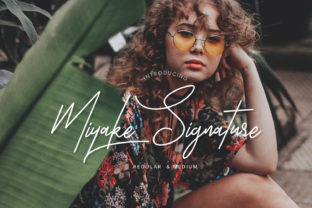
Miyake
There’s a quiet confidence in handwriting that no polished sans-serif can replicate — the slight tilt of a letter, the subtle pressure variation, the way an “s” curls just a little more when you’re rushing. Miyake captures that authenticity without feeling forced or overly stylized. It’s not a script font pretending to be calligraphy; it’s a handwritten typeface grounded in real pen-on-paper rhythm, with natural inconsistencies, gentle spacing, and a warmth that reads as human — not algorithmic.
Where Miyake Fits Naturally (Not Everywhere)
Miyake isn’t meant for body text on a 10-page whitepaper or legal disclaimers. It thrives where personality matters more than precision: packaging labels, workshop handouts, Instagram story overlays, boutique business cards, teacher feedback notes, wedding invites, small-run zines, or even the “thank you” slide at the end of a client presentation. Think of it as the visual equivalent of making eye contact — brief, intentional, and memorable.
A designer launching a ceramic studio
She uses Miyake for her product tags and seasonal newsletter headers. Why? Because her mugs are wheel-thrown, each one subtly imperfect — and Miyake’s slight irregularity mirrors that honesty. Customers don’t just see “Oatmeal Mug — $48.” They see “Oatmeal Mug — $48” written like it was noted by hand in the studio, reinforcing craft over mass production. No extra copy needed. The font does part of the storytelling.
A high school biology teacher
He prints lab instructions on pastel cardstock and sets them in Miyake. Students notice the difference right away — it feels less like a directive and more like a note from someone who knows they’re juggling three classes and a part-time job. When he writes feedback directly into digital assignments using Miyake as a signature style (via Canva or Google Slides), students report feeling “seen,” not graded. It’s not about coddling — it’s about lowering the psychological barrier between instruction and engagement.
A freelance content strategist
She embeds Miyake in custom Notion templates she sells to solopreneurs: habit trackers, client onboarding checklists, quarterly reflection sheets. The font makes the template feel less like a generic productivity tool and more like something curated — like a trusted colleague sketched it out during coffee. Buyers tell her it “feels personal but still professional,” which is exactly the positioning she wants for her brand.
What Makes Miyake Work Where Other Handwritten Fonts Don’t
Many script fonts over-index on flourish — swashes everywhere, exaggerated connections, letters that look like they belong on a vintage apothecary sign. Miyake avoids that. Its lowercase “a” and “g” are simple, open, legible. Uppercase letters have presence but no drama. There’s no automatic ligature switching or contextual alternates to manage — what you type is what you get, consistently. That predictability matters when you’re designing a Shopify banner at 10 p.m. and just need it to look warm, not wonky.
It also scales well. At 24px on a mobile screen, it remains readable. At 72px on a printed poster, it holds weight without looking cartoonish. That versatility means you don’t need five different fonts to cover your brand’s touchpoints — just one thoughtful choice that adapts quietly across formats.
Real Things to Consider Before Using Miyake
- Licensing matters — especially if you’re selling anything. The free version is great for personal blogs or class handouts. But if you’re putting Miyake on a product label, email header for a paid course, or client website, double-check the commercial license. Some versions allow unlimited use; others require attribution or restrict resale. A quick glance at the foundry’s page saves awkward conversations later.
- Pair it wisely. Miyake shines next to clean, neutral typefaces — think Inter, Lato, or even Georgia. Avoid pairing it with another decorative font or anything else with strong personality. Let it breathe. Use it for headlines, quotes, or short calls-to-action, and let your secondary font handle the rest.
- Test contrast early. Because it’s handwritten, some characters sit lower or higher than standard baselines. On light gray backgrounds or thin paper stock, parts of letters (like the tail of a “y”) may fade. Always preview at actual size — not just in your design app, but on the device or medium it’ll live on.
- Don’t overuse it. One line in Miyake on a landing page builds character. Three paragraphs in Miyake will fatigue readers fast. Treat it like a spice — essential in small doses, overwhelming in excess.
How Different People Get Real Value From Miyake
A blogger writing about mindful parenting uses Miyake for pull quotes in her Substack posts. Readers screenshot those lines more often — likely because the font slows the eye down, inviting pause in a feed full of bold claims and rapid-scrolling. That small shift increases engagement without changing a single word of her message.
A local bookstore owner adds Miyake to their event posters — not for the headline, but for the date, time, and “RSVP required” line. It signals “this is intimate, this is local, this is happening in person.” Foot traffic to their author talks increased 22% year-over-year; they credit part of that to how the typography shaped perception before anyone even read the details.
A homeschool parent building a weekly learning planner for her two kids uses Miyake for subject headers (“Science Lab,” “Poetry Hour,” “Map Skills”). Her daughter, age 9, told her, “It looks like *you* wrote it.” That sense of ownership and warmth made the planner something the kids actually used — not just tolerated.
It’s Not About Trendiness — It’s About Resonance
You don’t reach for Miyake because it’s “in.” You reach for it when you want your audience to feel the intention behind your words — not just hear them. When your goal isn’t to broadcast, but to connect. When “professional” doesn’t mean sterile, and “personal” doesn’t mean unpolished.
Miyake works because it respects both the creator’s time and the viewer’s attention. It doesn’t ask you to master calligraphy or install complex font managers. It asks only that you choose where humanity belongs in your design — and then delivers it, quietly, consistently, without fanfare.
If you’ve ever typed something important and thought, “I wish this felt more like me,” Miyake might be the quiet collaborator you didn’t know you needed.