Velvet Lousitone Duo: A Practical Evaluation for Designers
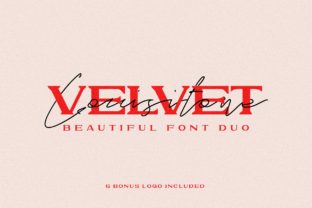
Velvet Lousitone Duo is a coordinated font pair consisting of a flowing signature-style script and a complementary hand-drawn serif. Unlike standalone typefaces, it is designed as an integrated system—both fonts share consistent weight contrast, x-height alignment, and stylistic rhythm to support cohesive visual hierarchy without manual tuning.
Designers often seek paired fonts that simplify typographic decision-making while preserving expressive potential. Velvet Lousitone Duo addresses this need by offering two distinct yet harmonized voices: the script conveys warmth and personality, while the serif provides grounded readability for supporting text. It is not a variable font or a single-family expansion, but a purpose-built duo intended for intentional pairing from the outset.
When Velvet Lousitone Duo Fits Your Project Goals
This duo works well in contexts where authenticity, approachability, and subtle craftsmanship are priorities. Examples include boutique branding (e.g., artisanal food labels, independent bookshops), wedding stationery, editorial features with a personal voice, and small-batch product packaging. Its hand-drawn qualities lend themselves to designs avoiding corporate sterility—especially where human touch matters more than rigid precision.
The script functions best at larger sizes—as headlines, logos, or short quotes—where its organic flow remains legible. The serif performs reliably in body copy down to 14–16px, depending on line length and medium. Both fonts include standard Latin character sets and basic OpenType features like ligatures and alternate glyphs, though advanced language support (e.g., extended Cyrillic or Vietnamese diacritics) is limited.
Practical Benefits to Consider
- Time efficiency: No need to test dozens of pairings—the script and serif were developed together, reducing trial-and-error in layout stages.
- Consistent tone: The shared design DNA helps maintain voice across headlines, subheads, and body text, especially in print or static digital assets.
- Distinctive but restrained: It avoids overused “handwritten” clichés by balancing irregularity with structural clarity—neither overly ornate nor artificially uniform.
- Light file footprint: As a two-font package, it adds minimal weight to web projects when loaded selectively (e.g., via
@font-facewithfont-display: swap).
Tradeoffs and Realistic Expectations
Velvet Lousitone Duo is not optimized for high-density information environments. Its script lacks the neutrality required for data tables, UI labels, or long-form web reading. Similarly, the serif’s hand-drawn texture reduces legibility in low-resolution displays or at very small sizes (<12px), making it less suitable for mobile interface text or accessibility-critical interfaces.
It also assumes a certain level of typographic control. While the fonts align well out of the box, fine-tuning spacing (especially between script and serif in tight hierarchies) may still require manual attention—kerning pairs are present but not exhaustive. Users working in constrained CMS environments or template-driven platforms may find limited access to stylistic alternates or contextual substitutions.
Licensing is another consideration. Velvet Lousitone Duo is typically sold under a desktop + web license; extended use (e.g., in mobile apps or SaaS platforms) may require additional permissions. Always verify license scope before committing to large-scale implementation.
Situations Where Alternatives May Be More Appropriate
If your project demands strict accessibility compliance—including WCAG AA/AAA contrast and screen reader compatibility—the script component will likely fall short as primary navigation or instructional text. In those cases, a highly legible sans-serif pair (e.g., Inter + Recursive, or IBM Plex Sans + Serif) offers stronger functional grounding.
For enterprise branding systems requiring scalability across dozens of languages, technical documentation, or multilingual marketing campaigns, fonts with broader Unicode coverage and professional hinting (e.g., Source Serif Pro + Source Sans Pro, or Noto Serif + Noto Sans) provide more predictable rendering and localization support.
Similarly, if your workflow relies heavily on dynamic text generation—such as personalized email headers or real-time dashboard titles—the variability in script letterforms can introduce inconsistency. A tightly engineered script with robust OpenType feature support (e.g., Bello Pro or Druk Wide) may offer greater automation reliability.
Making a Confident Decision
Evaluate Velvet Lousitone Duo against three practical criteria: purpose, audience, and execution context.
- Purpose: Does your project benefit from perceived warmth and craft? If your goal is clarity, speed, or neutrality—like a financial dashboard or legal notice—this duo is unlikely to serve the objective.
- Audience: Will viewers interact with the typography in conditions where texture and variation enhance engagement (e.g., a printed invitation, gallery wall text) or hinder it (e.g., a public kiosk with glare, aging eyesight)? Match the font’s expressive qualities to how and where people will encounter it.
- Execution context: Do you have the tools and time to adjust tracking, leading, and fallback behavior? If you’re using a no-code website builder with limited font controls, test how the duo renders across devices before finalizing. If you’re coding custom CSS, you’ll have more flexibility to refine vertical rhythm and responsive sizing.
Try exporting a short sample layout—headline, subhead, and two lines of body text—and view it at actual size on both screen and print. Pay attention not just to aesthetics, but to whether meaning stays clear at a glance. Does the script distract from the message, or does it invite closer reading? Does the serif sustain attention through a paragraph, or does its texture fatigue the eye?
Finally, compare Velvet Lousitone Duo against one or two alternatives using the same content and constraints. A side-by-side test—same hierarchy, same color, same container width—reveals more than feature lists ever can. Typography is ultimately about performance: how well it carries meaning, supports function, and respects the viewer’s time and attention.
If your work sits at the intersection of storytelling and design—where voice matters as much as structure—Velvet Lousitone Duo offers a thoughtful, ready-to-deploy option. But its value emerges only when matched deliberately to intent, not applied generically. Like any tool, its usefulness depends less on what it is, and more on how—and why—you choose to use it.