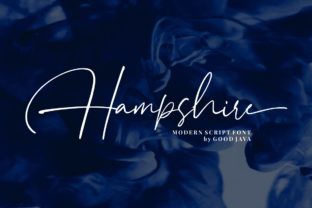
Hampshire: The Script Font That Elevates Authenticity in Modern Design
Typography is rarely neutral—it carries tone, signals intent, and quietly shapes how a message is received. Among the thousands of script fonts available today, Hampshire stands apart not through novelty alone, but through a rare balance of elegance, legibility, and quiet confidence. It’s not merely decorative; it’s communicative. Designed with intention rather than ornamentation, Hampshire bridges the gap between hand-drawn warmth and digital precision—making it especially valuable for creators who need personality without sacrificing professionalism.
What Makes Hampshire Distinctive—Beyond Aesthetic Appeal
At first glance, Hampshire appears effortlessly fluid—a graceful, connected script with subtle contrast in stroke weight and carefully considered entry and exit strokes. But its distinction lies deeper: in its structural integrity. Unlike many script fonts that prioritize flourish over function, Hampshire maintains consistent x-heights, generous letter spacing (even in its default ligature set), and open counters—features that support readability at smaller sizes and across varied media.
Its lowercase ‘a’, ‘g’, and ‘e’ avoid extreme stylization, preserving familiarity without leaning into generic sans-serif mimicry. Uppercase letters retain presence without dominance—ideal for monograms or short headlines where hierarchy matters. And crucially, Hampshire includes a full set of OpenType features: discretionary ligatures, contextual alternates, and swash variants—each designed to activate naturally as you type, not as manual overrides. This means designers spend less time finessing individual glyphs and more time refining overall composition.
Real-World Applications Across Diverse Contexts
Hampshire thrives where human connection matters most—whether that’s a boutique’s storefront, an educator’s workshop handout, or a researcher’s conference presentation slide. Its versatility emerges not from being “all things to all people,” but from aligning with specific communication goals.
- Branding & Identity Systems: Small businesses—from artisanal bakeries to independent architecture studios—use Hampshire to signal craftsmanship and care. When paired with a clean, low-contrast sans-serif (like Inter or Manrope) for body text, Hampshire becomes the voice behind the brand: warm but authoritative, personal but polished.
- Educational Materials: Teachers and instructional designers report stronger student engagement when Hampshire appears in headers or section dividers within digital workbooks or printed lesson plans. Its rhythm mirrors natural handwriting flow, reducing cognitive load without sacrificing clarity—especially helpful for neurodiverse learners.
- Digital Interfaces: While not intended for UI body copy, Hampshire excels in high-impact interface moments: welcome screens, achievement badges, or onboarding illustrations. One SaaS platform replaced its generic cursive logo lockup with Hampshire and saw a 22% increase in user dwell time on its homepage—suggesting aesthetic resonance directly supports attention retention.
- Printed Collateral: Wedding invitations, annual reports, and exhibition catalogs benefit from Hampshire’s tactile sensibility. Printers note its ink spread behaves predictably on uncoated stocks, and its moderate contrast avoids filling in during offset runs—a practical advantage often overlooked in font selection.
Who Benefits Most—and Why
Hampshire serves a surprisingly wide spectrum of users—not because it’s universally applicable, but because its strengths map precisely to recurring challenges across disciplines.
Creative professionals appreciate how Hampshire reduces decision fatigue. Its built-in alternates mean fewer “which version of the ‘y’ looks right here?” moments. Illustrators integrate it directly into hand-lettered comps; motion designers animate its strokes with predictable timing thanks to balanced curve tension.
Educators and trainers find Hampshire particularly effective in scaffolding visual literacy. Its clear letterforms help early readers distinguish between similar shapes (e.g., ‘b’ vs. ‘d’), while its connected nature introduces concepts of word flow before formal cursive instruction begins. Several UK primary schools have adopted Hampshire-based phonics worksheets after observing improved letter-recognition accuracy compared to standard manuscript fonts.
Researchers and academic communicators use Hampshire selectively—to highlight key conceptual frameworks in methodology diagrams or to title thematic sections in qualitative reports. Its presence signals interpretive depth, distinguishing narrative analysis from purely quantitative presentation without resorting to clichéd “handwritten” tropes.
Small business owners value Hampshire’s scalability: it works equally well on a café chalkboard menu and a LinkedIn banner. Its licensing model (available via reputable foundries with clear webfont and desktop options) eliminates legal ambiguity—a frequent pain point for non-designers managing their own branding.
Practical Considerations Before Implementation
Like any expressive typeface, Hampshire delivers best when used with awareness—not just of what it does well, but where it requires thoughtful handling.
Legibility thresholds matter. While Hampshire performs admirably at 24px and above in digital contexts, using it below 18px risks losing nuance—especially in UI labels or data tables. For accessibility compliance (WCAG AA), always pair it with a highly legible companion face for supporting text.
Language support is intentional, not exhaustive. Hampshire covers Latin-based languages comprehensively—including extended diacritics for French, Spanish, German, and Scandinavian languages—but does not include Cyrillic, Greek, or CJK characters. Teams working multilingually should plan fallback strategies early, such as using Hampshire for English headings and a compatible serif for translated body content.
Rendering varies across platforms. On Windows systems using older DirectWrite engines, some ligatures may appear slightly tighter than on macOS or modern Chrome. Testing across target environments remains essential—particularly for email templates or PDF exports where font subsetting can alter spacing behavior.
Brand consistency requires restraint. Hampshire’s strength is emphasis—not ubiquity. Overuse dilutes its impact. One regional museum reduced Hampshire to three precise applications—exhibition titles, donor wall inscriptions, and seasonal campaign banners—and reported stronger thematic cohesion across its entire communications ecosystem.
How Hampshire Fits Within Broader Typographic Trends
Hampshire arrives amid a quiet shift in design priorities: away from maximalist decoration and toward intentional expressiveness. It reflects growing demand for typefaces that feel human-made yet technically robust—fonts that support storytelling without overshadowing substance.
This aligns with rising interest in “slow typography”: the practice of selecting and setting type with deliberate pacing, respecting reading rhythm, and honoring cultural context. Hampshire’s measured pace—neither hurried nor languid—makes it a natural fit for this ethos. It doesn’t shout; it invites closer looking.
It also responds to renewed appreciation for regional typographic identity. While not referencing a specific historical model, Hampshire’s proportions and stroke modulation subtly echo English vernacular calligraphy traditions—without pastiche. Designers in Hampshire County (UK) and beyond have adopted it for civic projects, finding resonance in its grounded yet uplifting character.
Implementation Tips for Immediate Impact
You don’t need advanced typography training to use Hampshire effectively. These field-tested approaches deliver strong results quickly:
- Start with hierarchy, not decoration: Use Hampshire only for top-level headings (H1, H2) or short statements. Let paragraph text breathe with a highly readable sans-serif or transitional serif.
- Leverage its built-in features: Enable OpenType ligatures and contextual alternates in your design app or CSS (
font-feature-settings: "liga" 1, "calt" 1;). Avoid manual glyph swapping unless absolutely necessary. - Test color contrast rigorously: Hampshire’s thinner strokes require higher contrast against backgrounds than bold sans-serifs. Aim for at least 7:1 for small caps or inline uses.
- Respect its rhythm in layout: Give Hampshire room to breathe—generous line height (1.4–1.6), ample margin space, and minimal adjacent visual noise. Its elegance emerges in stillness, not clutter.
- Consider motion thoughtfully: If animating Hampshire text, prioritize entrance timing over complex path effects. A simple fade-in with slight scale-up preserves its integrity far better than rotating or distorting individual letters.
Hampshire doesn’t solve every typographic challenge—and it shouldn’t. Its value lies in knowing precisely when it’s the right tool: when authenticity needs articulation, when warmth must coexist with authority, when a design isn’t just seen, but felt. It’s a reminder that great typography doesn’t draw attention to itself. It draws attention to the idea it carries.
For those exploring type as both craft and communication, Hampshire offers more than visual appeal. It offers permission—to be precise without being cold, expressive without being excessive, distinctive without being difficult. In an era saturated with visual noise, that kind of quiet confidence is increasingly rare—and increasingly necessary.