Ambrossius Script
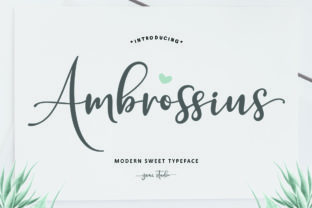
If you’ve ever stared at a design and thought, “It’s clean—but it’s missing warmth,” or “It’s professional—but where’s the personality?”—Ambrossius Script is likely the quiet solution you’ve been overlooking. It’s not just another handwritten font. It’s a premium font with intention: fluid yet grounded, playful but never childish, spontaneous without sacrificing legibility.
A Handwritten Font That Holds Its Ground
Ambrossius Script sits comfortably in the script font category—but avoids the pitfalls many do. Unlike overly ornate calligraphic fonts that vanish in small sizes or collapse under tight spacing, Ambrossius balances natural stroke variation with consistent rhythm. Its lowercase letters have subtle bounce; capitals carry confident weight without shouting. There’s a gentle tilt—not rigidly slanted, not lazily casual—just enough to feel human, like handwriting you’d trust on a hand-signed invitation or a small-batch product label.
What makes it truly distinctive is its “twist”: a few characters (like the lowercase g, y, and z) include delicate, unexpected flourishes—small loops or tapered exits—that catch the eye without distracting. They’re details you notice only on second glance, which gives designs depth over time—not just impact at first sight.
Where Ambrossius Script Earns Its Place
This isn’t a font for body text in long-form editorial design. It’s a display font—meant to anchor, invite, and distinguish. Think of it as the voice behind your brand’s most expressive moments:
- Logo design for creative studios, artisan bakeries, indie bookshops, or wellness brands—anywhere authenticity and approachability matter more than corporate rigidity;
- Packaging design for handmade soaps, small-batch hot sauces, or ceramic studios—where the font becomes part of the tactile experience;
- Social media graphics for quotes, limited-time offers, or event announcements—especially when paired with a neutral sans serif for contrast;
- Print collateral like wedding stationery, workshop handouts, or zine covers—where its warmth reinforces intimacy and care;
- Web design headers (H1s and hero text) on portfolios, landing pages, or boutique e-commerce sites—provided line-height and letter-spacing are adjusted for screen clarity.
It works especially well in contexts where audiences are choosing *who* they support—not just *what*. A coffee roaster using Ambrossius Script on their bag doesn’t just sell beans—it signals craft, attention, and human scale.
Readability Isn’t Just About Size—It’s About Context
Ambrossius Script remains highly readable at 24–36pt in print and 32–48px on screens—when used intentionally. Its x-height is generous, and letterforms avoid excessive overlap or tight counters. But it’s not meant for paragraphs, captions, or UI labels. Trying to force it into those roles undermines both its strength and your audience’s ease.
In practice, that means: use it where you want people to pause, not skim. A headline like “Hand-Poured Since 2017” in Ambrossius Script feels intentional and personal. The same phrase in 14pt body copy would fatigue readers and dilute your message.
Also worth noting: Ambrossius Script includes standard OpenType features—ligatures, stylistic alternates, and contextual swashes. These aren’t decorative extras. Turning on discretionary ligatures (fi, fl, ff) smooths rhythm in longer words. Swashes work beautifully on initial caps in invitations or chapter titles—but skip them in all-caps settings or tight spaces.
Pairing It Right—Without Overthinking
Great font pairing isn’t about contrast for contrast’s sake—it’s about creating visual hierarchy that guides the eye and supports meaning. Ambrossius Script pairs naturally with understated sans serifs: think Inter, Manrope, or Clash Grotesk. Their clean geometry lets Ambrossius breathe, while their neutrality keeps focus on your message—not the type.
Avoid pairing it with other scripts or high-contrast serifs. Two expressive voices compete; one usually loses. And resist the urge to “match energy” with a playful rounded sans—it often reads as unserious or juvenile next to Ambrossius’s grounded charm.
Real-world test: set your Ambrossius headline beside your chosen body font at actual usage size—on screen and printed. If the body text feels harder to read *because* of the headline’s presence, adjust tracking, weight, or switch pairings. Trust what your eyes tell you—not presets.
Licensing, Formats, and Practical Checks
Ambrossius Script is a commercial font—meaning it requires a license for any use beyond personal experimentation. Most licenses cover desktop, web, and app embedding, but always verify scope before launching a client project or product rollout. Some vendors offer extended licenses for unlimited impressions on websites or digital ads—worth checking if your site gets heavy traffic.
The font typically ships in OTF and WOFF2 formats, with full Latin character sets and basic diacritics (enough for English, Spanish, French, German). It does not include Cyrillic or extended Asian language support—so if your audience spans multilingual markets, plan supplemental type solutions.
Before finalizing a design: test Ambrossius Script across devices. On mobile, increase letter-spacing by 2–4% and ensure minimum headline size stays above 28px. In email clients, embed as SVG or rasterized image for headlines—don’t rely on web font loading.
Not Every Project Needs a Signature Font—But This One Fits When It Does
Ambrossius Script won’t fix weak messaging or inconsistent branding. But when your voice is warm, your process is hands-on, and your audience values sincerity over polish—it becomes a quiet amplifier. It’s the kind of design asset that doesn’t shout “look at me,” but makes people linger a half-second longer because something feels *right*.
Use it where craft meets clarity. Where personality isn’t added on—it’s built in.