Bread Store: A Strategic Choice for Distinctive Visual Communication
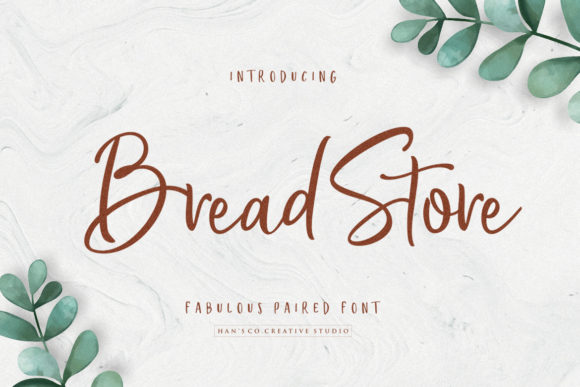
When selecting a typeface, most professionals focus on legibility, licensing, or trend alignment—yet few consider how deeply a font’s personality influences perception, memory, and emotional resonance. Bread Store is not just another script font. It’s a purpose-built duo: one weight leans into playful, exaggerated curls; the other refines those gestures into clean, modern swashes. This duality isn’t decorative—it’s functional. Used intentionally, Bread Store supports clarity of voice, strengthens brand distinction, and signals creative confidence without sacrificing sophistication.
Why Bread Store Fits Real-World Branding Strategy
Script fonts carry inherent risk: they can feel dated, overly casual, or difficult to read at scale. Bread Store avoids those pitfalls by anchoring its whimsy in structural discipline. Its letterforms maintain consistent stroke contrast and rhythm—even in its most exuberant iterations—so it performs reliably across contexts where tone matters more than neutrality. That makes it especially valuable for businesses and creators whose identity hinges on warmth, approachability, and authenticity: bakeries, boutique studios, independent educators, handmade goods brands, and lifestyle publishers.
Consider this: a local ceramics studio launching an online shop doesn’t need sterile minimalism to appear professional. They need visual language that conveys care, craft, and human touch. Bread Store delivers that—not as decoration, but as strategic shorthand. When paired with a restrained sans-serif for body text, it creates hierarchy with intention: the headline isn’t just “seen,” it’s felt. That emotional cue primes attention before a single word is read.
Where Bread Store Adds Value—And Where It Doesn’t
Bread Store excels in controlled, high-impact applications—not broad utility. Think of it like a well-chosen spice: essential in the right dish, overwhelming if overused. Use it where you want to:
- Signal personality in logo lockups or wordmarks (e.g., “Hearth & Loaf Bakery”)
- Elevate limited-run packaging or seasonal campaign assets
- Add character to invitation suites, workshop headers, or editorial pull quotes
- Differentiate a sub-brand or product line without reinventing core identity
It does not work well for long-form text, data-heavy dashboards, legal disclaimers, or interfaces requiring rapid scanning. Its charm lies in contrast—not consistency. Deploying Bread Store across every button, menu item, or email subject line dilutes its impact and undermines readability. That’s not a limitation of the font; it’s a reminder that typography serves communication first, aesthetics second.
Planning Your Use of Bread Store: Three Practical Steps
Before licensing or implementing Bread Store, ask three grounded questions:
- What outcome do I want this to drive? Is it recognition? Warmth? Memorability? If the goal is “looking trendy,” reconsider. If it’s “helping customers instantly associate our name with handmade quality,” Bread Store becomes a tactical asset.
- Where will this live—and how much control do I have over context? A custom-designed Instagram highlight icon benefits from Bread Store’s flair. A third-party platform with fixed font stacks does not. Audit your key touchpoints: website CMS, email builder, print vendor specs, social media templates.
- Does it coexist clearly with my supporting type system? Pair Bread Store with a neutral, highly legible sans-serif (like Inter, Poppins, or DM Sans) that shares similar x-height and optical balance. Avoid clashing weights or competing personalities—your pairing should feel like conversation, not competition.
Avoiding Common Strategic Pitfalls
The biggest risk with Bread Store isn’t technical—it’s conceptual. Using it without aligning it to audience expectations or business goals turns expressive typography into visual noise. For example, a financial advisor targeting retirees might unintentionally undermine trust by leading with Bread Store in their homepage headline. The font’s energy reads as informal, even playful—clashing with the gravitas their clients seek.
Similarly, applying Bread Store to multilingual content demands testing. Its curls and swashes may not translate gracefully across non-Latin scripts or complex diacritics. If your audience includes Spanish, Vietnamese, or Arabic speakers, verify glyph coverage and test rendering at multiple sizes before finalizing layouts.
Another subtle misstep: treating Bread Store as a “quick brand refresh.” Fonts don’t reposition businesses alone. If your messaging lacks clarity or your customer experience feels inconsistent, swapping in Bread Store won’t fix underlying gaps—it may only highlight them. Use it as reinforcement, not substitution.
Long-Term Thinking: How Bread Store Supports Sustainable Branding
Many script fonts age poorly because they chase momentary trends—think excessive bounce, forced irregularity, or exaggerated ligatures. Bread Store avoids that trap. Its curves are intentional, not arbitrary; its swashes are refined, not frantic. That restraint gives it staying power. A brand that launched with Bread Store in 2023 can still use it confidently in 2028 without appearing outdated—provided usage remains disciplined and context-aware.
This longevity matters for small businesses and solopreneurs who lack resources for frequent rebrands. Investing time in thoughtful application—rather than chasing the next aesthetic shift—builds equity. Every time a customer recognizes your logo or remembers your workshop title because of how Bread Store shaped its presence, you’re reinforcing neural pathways tied to your value proposition.
Realistic Implementation Tips for Busy Professionals
You don’t need design expertise to use Bread Store effectively. Start small and scale deliberately:
- Begin with one anchor use case: Redesign your email signature or newsletter header. Track open rates and reply tone over six weeks—not for statistical significance, but for qualitative shifts in how people respond to your voice.
- Leverage built-in OpenType features: Many versions of Bread Store include stylistic alternates, swash capitals, and contextual ligatures. Enable these in design tools (Figma, Illustrator) or via CSS (
font-feature-settings: "swsh", "calt") to add nuance without manual adjustments. - Test at real-world sizes: Display Bread Store at 24px on mobile, 48px on desktop banners, and 12pt on printed business cards. Does the curl in the lowercase “g” remain legible? Does the uppercase “Q” retain its elegance? Adjust tracking or size before committing to production.
Remember: the goal isn’t to make everything “look nice.” It’s to ensure every typographic choice quietly supports your larger objectives—whether that’s building trust with new clients, guiding learners through complex material, or helping a community recognize shared values at a glance.
Final Thought: Typography as Quiet Leverage
Bread Store works best when treated not as ornament, but as quiet leverage—a tool that amplifies what’s already strong in your message, your mission, or your craft. It rewards patience, precision, and planning. Used without purpose, it fades into background noise. Used with clarity, it becomes part of why people remember you, return to you, and recommend you. That kind of resonance doesn’t come from picking the “most popular” font. It comes from choosing the one that aligns—strategically, honestly, and consistently—with who you are and who you serve.