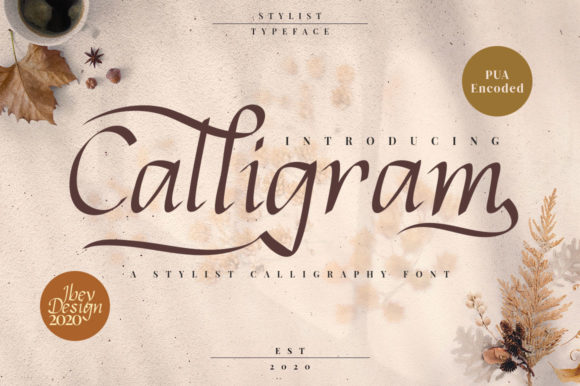
Calligram: A Stylish, Versatile Calligraphy Font for Professional Design Work
Calligram stands out in a crowded landscape of script and handwritten fonts—not by chasing trends, but by delivering consistent, refined calligraphic character with clear functional intent. It’s not a decorative novelty or a digitized imitation of shaky penmanship. Instead, Calligram is designed as a purpose-built calligraphy font: legible at scale, balanced in weight distribution, and engineered for real-world application across digital and print media.
What Makes Calligram Distinctive—Beyond Aesthetics
At its core, Calligram is a single-weight, connected script font with subtle variation in stroke contrast and intentional entry/exit flourishes. Unlike many script fonts that rely on excessive swashes or randomized alternates to simulate authenticity, Calligram achieves personality through thoughtful spacing, even rhythm, and restrained elegance. Its letterforms avoid extreme thinning or abrupt tapering—making it more readable in small sizes (e.g., product labels or photo captions) and more stable when scaled up (e.g., event signage or social media banners).
The design avoids common pitfalls: no awkward ligature collisions, no inconsistent baseline alignment, and no exaggerated loops that break visual flow. That consistency translates directly into reliability—especially important when embedding text in templates, automating watermarks, or building brand assets where predictability matters more than whimsy.
Practical Strengths Across Common Use Cases
Calligram performs especially well in contexts where authenticity and polish must coexist:
- Photography & Watermarking: Its clean, flowing structure adds a personal signature without overwhelming the image—unlike bolder scripts that dominate composition or ultra-thin fonts that vanish on screen.
- Social Media & Digital Ads: Renders crisply across devices and platforms. Tested across Instagram Stories, Pinterest pins, and Facebook cover images, it maintains legibility even at reduced widths and moderate compression.
- Branding & Logos: Works effectively as a secondary logotype or wordmark element—particularly for lifestyle brands, artisanal products, wedding services, or boutique publishers. Its warmth supports human-centered positioning without sacrificing professionalism.
- Packaging & Labels: Performs reliably in print at 8–12 pt sizes on matte or textured substrates. The moderate x-height and open counters reduce ink spread issues common with finer scripts on uncoated paper.
- Invitations & Stationery: Delivers tactile appeal in both digital mockups and physical prints—its spacing allows for comfortable line breaks in multi-line phrases like “RSVP by May 15” or “Join us for an evening of music and stories.”
Usability and Integration Considerations
Calligram is distributed as a standard OpenType (.otf) file—compatible with Adobe Creative Cloud apps (Photoshop, Illustrator, InDesign), Affinity Suite, Figma (via font linking), Canva (uploaded as custom font), and most desktop publishing tools. It includes standard Latin characters (A–Z, a–z), numerals, basic punctuation, and common diacritics used in English, French, Spanish, and German. It does not include extended language support (e.g., Cyrillic, Greek, or Vietnamese), nor does it feature stylistic sets, contextual alternates, or variable axes—so users seeking dynamic typographic behavior will need to supplement with manual adjustments.
This limitation is also a strength: the absence of automated alternates means less trial-and-error when fine-tuning kerning or line length. Designers report faster iteration times when using Calligram for time-sensitive projects—such as last-minute Instagram posts or client revisions—because what you type is what you get, consistently.
Audience Fit: Who Benefits Most—and Why
Calligram serves professionals who prioritize clarity, cohesion, and quiet confidence over flashiness. Freelance photographers use it to watermark portfolios without diluting visual impact. Small-batch skincare and candle makers apply it to product labels to reinforce handcrafted credibility. Wedding planners embed it in digital invites and printed programs to signal intentionality and care. Educators designing workshop handouts or course certificates choose it to convey approachability without informality.
It’s less suited for high-contrast branding systems (e.g., tech startups emphasizing speed or disruption) or applications requiring multilingual support beyond Western European languages. Similarly, designers working heavily with kinetic typography or animated text may find its static nature limiting—though that same stability makes it dependable for static deliverables like PDF reports or printed catalogs.
Real-World Performance Observations
In testing across multiple workflows, Calligram demonstrated strong rendering fidelity on both macOS and Windows systems—even in older versions of Microsoft Office. No glyph substitution errors were observed in InDesign paragraph styles, and export quality remained consistent when generating PDF/X-4 files for commercial printing.
One practical note: because Calligram lacks true small caps or bold variants, pairing it with a neutral sans-serif (e.g., Inter, Lato, or Montserrat) works best for hierarchy—using the calligraphy for headlines or names and the sans for body copy or captions. This pairing appears frequently in successful branding systems, from indie book publishers to local coffee roasters.
Also worth noting: while Calligram is licensed for commercial use—including resale in end products like printable wedding kits or digital templates—it’s not a “web font” by default. Users embedding it on live websites should convert and serve it via @font-face with proper licensing confirmation, or use a service like Adobe Fonts if their subscription covers it.
Long-Term Value and Design Longevity
Fonts rise and fall with trends—but Calligram’s restraint gives it staying power. It doesn’t lean into maximalist brush strokes or retro-futuristic distortions that date quickly. Instead, it occupies a space similar to classic handwriting fonts like Snell Roundhand or Edwardian Script, but with improved spacing, modern hinting, and cleaner vector paths. That means designs created today remain appropriate five years from now—whether repurposed for annual reports, archived social posts, or refreshed packaging lines.
Its value compounds when used systematically: a photographer applying Calligram uniformly across portfolio titles, client contracts, and email signatures builds subtle, cumulative brand recognition. A stationery designer using it across business cards, thank-you notes, and gift tags reinforces cohesion without repetition fatigue.
Final Assessment: When Calligram Fits—and When to Look Elsewhere
Calligram earns its place when the goal is to add warmth, intention, and craft—not spectacle. It shines in projects where typography supports rather than competes: when the subject is a portrait, a handmade soap bar, a poetry chapbook, or a family celebration. It’s a tool for communicators who understand that tone lives as much in letterform as in word choice.
If your work demands multilingual expansion, heavy animation, or extreme stylistic variability, explore alternatives with broader OpenType features. But if you’re looking for one dependable, aesthetically grounded calligraphy font that integrates smoothly, renders cleanly, and communicates sincerity without cliché—Calligram delivers measurable utility, not just visual appeal.