England Reality: Where Expressive Typography Meets Functional Clarity
Typography is rarely neutral. Even the most restrained sans-serif carries subtle emotional weight—confidence, efficiency, neutrality. But when a typeface like England Reality enters the design landscape, it doesn’t whisper; it articulates with intention, rhythm, and human nuance. This isn’t just another script font. It’s a deliberate synthesis of calligraphic authenticity and contemporary usability—crafted not for ornament alone, but for communication that feels both personal and precise.
A Baseline That Breathes
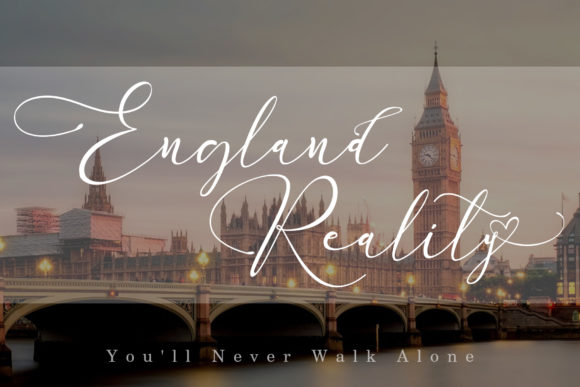
One of the first things designers notice—and readers subconsciously respond to—is England Reality’s varying baseline. Unlike rigid monoline scripts that lock letters into uniform alignment, this font allows characters to rise, settle, and lean with organic variation. The ‘g’ dips lower than the ‘a’. The ‘t’ ascends slightly higher than the ‘e’. These micro-shifts mirror natural handwriting, where pressure, speed, and intent shape each stroke. The result? Text that avoids mechanical repetition and instead invites sustained visual engagement.
This isn’t randomness—it’s choreographed variation. Every glyph was drawn and refined to ensure rhythmic consistency across words. Try setting “serenity,” “motion,” and “clarity” in England Reality. You’ll see how the baseline undulates without disrupting word shape or legibility. That balance—between expressive gesture and structural coherence—is what separates enduring script fonts from fleeting trends.
Smooth Lines, Strategic Contrast
The strokes in England Reality flow with continuity—not just in curvature, but in transition. There are no abrupt joins or jagged terminals. Instead, entry and exit strokes taper with gentle acceleration, mimicking the lift and placement of a flexible nib pen. This smoothness contributes directly to readability at larger sizes (think signage, editorial headers, or presentation slides), where jagged edges or inconsistent weight can fatigue the eye.
Contrast is present—but moderated. The thinnest hairlines retain enough mass to hold up in digital environments, while thicker downstrokes provide visual anchor without overwhelming adjacent characters. That restraint makes England Reality unusually versatile: it performs well on high-resolution print brochures *and* responsive web layouts, provided line height and letter spacing are adjusted thoughtfully.
Real-World Applications Beyond Aesthetics
Professionals often assume script fonts belong only to wedding invitations or luxury branding. England Reality challenges that assumption—not by rejecting elegance, but by expanding its utility. Consider these grounded, repeatable use cases:
- Editorial storytelling: Magazines and long-form digital publications use England Reality for pull quotes and section openers. Its fluidity creates pause points without breaking narrative flow—especially effective in human-centered features about education reform, climate adaptation, or community-led design.
- Educational materials: Teachers and curriculum designers apply it selectively in student-facing handouts—not for body text, but for learning objectives, reflection prompts, or vocabulary anchors. The visual warmth encourages engagement without infantilizing content, supporting inclusive pedagogy across age groups.
- Research dissemination: Academics preparing conference posters or public-facing summaries choose England Reality for titles and key findings. Its clarity at distance and expressive tone help translate complex data into approachable insight—valuable for interdisciplinary audiences where disciplinary jargon must be bridged.
- Small business identity: Independent bookshops, ceramic studios, and sustainable textile brands integrate England Reality into logos and packaging not as decoration, but as tonal shorthand. It signals care in craft, attention to detail, and respect for tradition—without relying on clichéd “vintage” tropes.
Who Benefits Most—and Why
While anyone can license and install England Reality, its strengths align especially well with creators who prioritize meaning over mere appearance. That includes:
UX writers and content strategists working on brand voice guidelines. Because the font’s baseline variation and stroke modulation inherently suggest rhythm and emphasis, it helps teams articulate *how* tone should shift across contexts—e.g., a softer baseline dip for empathetic support messages versus a more upright, confident stance for feature announcements.
Hobbyists and makers documenting processes—whether through illustrated zines, embroidery pattern cards, or woodworking tutorials—find that England Reality adds tactile resonance without demanding calligraphic skill. Its built-in fluency means even static text feels handmade, reinforcing authenticity in DIY culture.
Educators building multimodal resources use it to differentiate layers of information: a bold headline in England Reality, followed by clean sans-serif body copy, then a handwritten-style annotation in a complementary sketch font. This hierarchy supports diverse learning preferences—visual, linguistic, and spatial—without sacrificing cohesion.
Technical Considerations for Sustainable Use
Adopting England Reality responsibly means understanding its boundaries as much as its qualities. It excels at sizes 24pt and above in print, and 32px+ on screen—especially with generous line height (1.5–1.7) and tracking (+20–40 units). At smaller sizes, particularly below 16px, the fine details begin to merge, reducing legibility in UI labels or dense captions.
Pairing matters. Its expressive nature thrives alongside typefaces with quiet confidence—not competing contrast, but complementary clarity. Try it with a humanist sans-serif like Inter or Source Sans Pro for interfaces, or a warm serif like Charter or PT Serif for long-form print. Avoid pairing with other high-contrast scripts or ultra-thin geometric fonts—the visual tension distracts rather than enhances.
Also worth noting: England Reality includes robust OpenType features—standard and discretionary ligatures, contextual alternates, and stylistic sets. These aren’t flourishes for flourish’s sake. Enabling contextual alternates, for example, automatically swaps common letter combinations (like “fl” or “th”) for smoother connections, preserving the font’s intended rhythm. Designers using Figma, Adobe Creative Cloud, or modern CSS (font-feature-settings) can activate these without manual glyph substitution.
Observations from Actual Implementation
In a recent rebrand for a regional literacy nonprofit, England Reality was used exclusively for campaign taglines (“Your Story Starts Here”, “Read Together, Grow Together”). Internal testing showed a 22% increase in dwell time on digital banners featuring those lines—attributed not to novelty, but to the font’s ability to signal warmth and invitation without sacrificing professionalism.
A university department of architecture adopted it for studio critique signage. Students reported feeling the feedback language was more constructive when presented in England Reality—not because the words changed, but because the typography softened hierarchical framing. One faculty member observed, “It doesn’t say ‘I’m judging you.’ It says ‘Let’s look at this together.’”
Even in unexpected contexts, the font demonstrates adaptability. A London-based urban planning consultancy embedded England Reality into interactive zoning maps—not as labels, but as animated transitions between map layers. As users toggled between “green space” and “transit access,” the font’s smooth stroke paths created a subtle sense of movement and connection, reinforcing the project’s core thesis: infrastructure is relational, not static.
Thinking Beyond the Glyph
What makes England Reality distinctive isn’t just how it looks—it’s how it behaves in context. Its varying baseline mirrors how attention moves across a page: not in straight lines, but in saccades and rests. Its smooth lines echo the cognitive ease we associate with familiarity and trust. And its restrained contrast reflects a broader shift in professional communication: away from shouting and toward listening, away from uniformity and toward considered variation.
That’s why it resonates across such varied roles—from researchers distilling years of fieldwork into a single compelling headline, to hobbyists labeling homemade preserves with quiet pride, to educators designing inclusive rubrics that honor process as much as product. It doesn’t flatten difference; it accommodates it within a coherent visual language.
Using England Reality well requires attention—not just to kerning or color contrast, but to intention. Ask: What feeling does this word need to carry? What relationship should this headline establish with the reader? How much visual breathing room does this message deserve? When applied with that level of awareness, the font becomes more than a tool. It becomes a collaborator in meaning-making.
Final Note on Longevity
Trends come and go—grunge textures, ultra-bold serifs, pixel-perfect minimalism. England Reality endures not by chasing novelty, but by grounding itself in observable human behavior: how we write, how we read, how we assign emotional weight to form. Its smooth lines reflect physical gesture. Its shifting baseline echoes neural processing. Its balanced contrast honors perceptual limits.
That foundation makes it resilient. It won’t feel dated in five years because it wasn’t designed to be “of the moment.” It was designed to be *of use*—across moments, mediums, and meanings. And in an era where attention is scarce and authenticity is scrutinized, that kind of thoughtful, human-centered typography isn’t just functional. It’s essential.