Rinjane: A Bold Handwritten Font for Expressive, High-Impact Typography
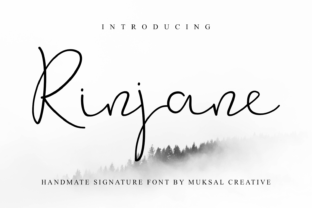
Rinjane is a distinctive handwritten font designed to deliver visual energy without sacrificing legibility. Unlike many script fonts that lean into delicate flourishes or casual informality, Rinjane balances organic flow with confident weight—its strokes are intentionally thick, its rhythm assertive, and its character set built for clarity at medium to large sizes. It’s not a “just add flair” decorative typeface; it’s a deliberate typographic tool suited for contexts where personality and presence matter equally.
What Sets Rinjane Apart from Other Handwritten Styles
Most handwritten fonts fall along a spectrum—from airy and minimalist (think light-weight brush scripts) to dense and ornate (with heavy swashes and overlapping connections). Rinjane occupies a less common middle ground: it’s bold enough to command attention in headlines or logos, yet retains the warmth and human imperfection of hand-drawn lettering. Its lowercase ‘g’, ‘y’, and ‘q’ feature subtle but intentional descenders that anchor lines without cluttering them. Uppercase letters avoid excessive exaggeration—no looping ‘Q’s or overextended ‘J’s—making Rinjane more versatile across branding systems than many high-contrast alternatives.
This restraint contributes to Rinjane’s functional strength. While some bold scripts sacrifice readability below 36pt, Rinjane remains legible down to 24pt in print and 28px on screen—provided line spacing and contrast are well managed. That practical threshold matters when evaluating options for packaging copy, event signage, or digital banners where hierarchy and scannability are non-negotiable.
Where Rinjane Fits in Real-World Design Workflows
Designers often reach for handwritten fonts in three primary scenarios: brand identity (logos, wordmarks), editorial emphasis (magazine pull quotes, book chapter openers), and marketing assets (social graphics, email headers). Rinjane excels in the first two—but with important caveats.
- Logos & wordmarks: Rinjane’s strong x-height and consistent stroke weight help it scale cleanly across favicons, app icons, and embroidered apparel. Its lack of extreme ligatures means fewer kerning surprises during vector conversion.
- Editorial use: As a display face for short, impactful text—like a magazine’s section title or a podcast episode header—it adds voice without competing with body text. Its rhythm supports quick comprehension, unlike overly connected scripts that blur letter boundaries.
- Long-form or UI text: Rinjane isn’t built for paragraphs, captions, or interface labels. Its stylistic consistency begins to feel monotonous beyond two lines, and its limited OpenType features (no discretionary ligatures, stylistic sets, or contextual alternates) reduce flexibility in complex layouts.
In practice, this means Rinjane works best when paired intentionally—not as a standalone system font, but as part of a thoughtful typographic pair. For example, pairing Rinjane with a neutral, humanist sans-serif like Inter or Work Sans creates clear visual hierarchy: Rinjane sets tone and intention; the companion face delivers information efficiently.
Tradeoffs to Consider Before Choosing Rinjane
No font solves every problem—and Rinjane’s strengths come with realistic limitations. Understanding these helps avoid misalignment between intent and outcome.
First, Rinjane has a defined stylistic range. It conveys confidence, modernity, and approachable energy—but doesn’t suggest tradition, elegance, playfulness, or minimalism. If your project calls for quiet sophistication (e.g., a boutique law firm’s stationery) or childlike whimsy (e.g., a preschool newsletter), Rinjane’s boldness may unintentionally miscommunicate.
Second, language support is functional but not expansive. Rinjane includes Latin-based characters used in English, Spanish, French, German, and Portuguese—including accented vowels and common punctuation—but lacks extended Cyrillic, Greek, or Vietnamese glyph sets. Projects requiring multilingual consistency across broader European or global audiences will need verification or fallback planning.
Third, licensing and technical integration vary by vendor. Some platforms bundle Rinjane with basic webfont hosting; others require self-hosting or separate variable font setup. Unlike system fonts or widely distributed Google Fonts, Rinjane isn’t pre-installed on devices—so web use depends on proper loading strategy and performance optimization. Slow-loading custom fonts can impact perceived site speed, especially on mobile connections.
How Rinjane Compares to Broader Handwritten Categories
When evaluating handwritten fonts, it’s helpful to group them by structural behavior rather than just appearance. Rinjane belongs to the structured bold script category—characterized by uniform stroke weight, moderate slant, and restrained connections. This contrasts with:
- Loose brush scripts: These prioritize texture and spontaneity (e.g., irregular ink bleed, visible pressure variation). They’re expressive but often harder to scale or pair consistently. Rinjane trades that raw texture for reliability.
- Formal copperplate styles: Highly structured, with dramatic thick-thin contrast and precise entry/exit strokes. These communicate heritage or luxury—but require skilled typesetting and don’t adapt well to digital interfaces. Rinjane avoids that fragility.
- Minimalist handwritten sans: Often digitized from pencil sketches, these emphasize simplicity over gesture. They’re highly legible but risk feeling generic. Rinjane offers more distinctiveness while retaining clarity.
This positioning makes Rinjane especially relevant for teams balancing brand differentiation with production efficiency—startups refining their visual voice, creative agencies building scalable identity systems, or educators designing presentation templates that need to stand out without demanding custom illustration.
When Rinjane Is Likely the Right Choice
Rinjane fits most naturally when three conditions align:
- You need a handwritten aesthetic that communicates strength and approachability—not fragility or nostalgia.
- Your use case is limited to short, high-visibility text (under 10 words), where typographic personality enhances meaning rather than obscures it.
- You have control over supporting typography, color contrast, and layout spacing—so Rinjane’s boldness can be framed effectively, not overwhelmed.
Real examples include: a wellness brand’s logo lockup (where “Vital” or “Bloom” benefits from Rinjane’s grounded energy), an indie music festival’s poster headline (“Summer Nights • August 17”), or a nonprofit’s campaign banner (“Act Now • Your Voice Matters”). In each case, Rinjane contributes tonal clarity—not decoration.
When You Might Explore Alternatives Instead
Rinjane may not serve your needs if:
- You’re designing for accessibility-first environments (e.g., government services or educational platforms), where WCAG-compliant contrast and predictable letterforms take priority over stylistic distinction.
- Your content relies heavily on dynamic text generation—like user-generated quotes or data-driven headlines—where inconsistent spacing or glyph substitution could disrupt alignment.
- You require extensive language coverage, variable font axes (weight, width, slant), or advanced typographic controls (case-sensitive forms, fractions, ordinals) that Rinjane doesn’t provide.
In those cases, evaluating fonts with broader OpenType support, expanded character sets, or variable design architecture may better match long-term goals—even if they lack Rinjane’s immediate visual impact.
Making a Practical Decision
Choosing a font like Rinjane isn’t about finding the “best” option—it’s about matching expressive capability to functional requirements. Test it early in your process: set actual content (not placeholder text), preview across intended outputs (print mockups, mobile screenshots, dark-mode previews), and assess how it performs alongside your chosen body font and color palette.
If Rinjane feels confident, legible, and tonally accurate in those tests—and doesn’t introduce unexpected technical hurdles—it’s likely a sound choice. If it demands disproportionate adjustments to maintain readability or consistency, that’s useful data, not failure. The goal is informed alignment, not universal appeal.
Rinjane doesn’t try to be everything. It’s focused, intentional, and built for moments where handwriting should mean something—not just look interesting.