Hallo Oyster: When Handwritten Boldness Meets Design Integrity
Typography is rarely just about legibility—it’s about resonance. A font that lands with quiet authority in a corporate report, or one that pulses with irreverent charm on a café chalkboard, does more than convey words. It signals intention, evokes memory, and quietly shapes perception. Hallo Oyster belongs to the latter category: a distinctive handwritten script where confidence isn’t whispered—it’s sketched with deliberate, ink-rich strokes.
A Typeface That Breathes Like a Human
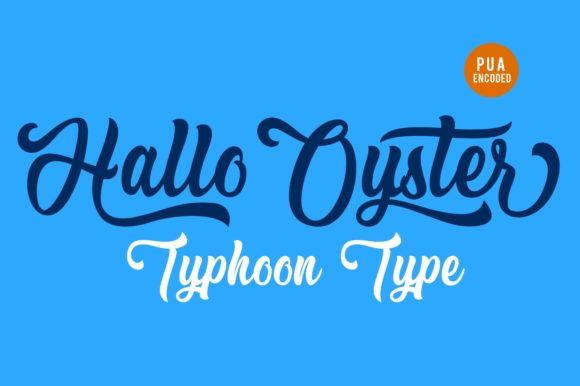
Unlike many decorative scripts that rely on uniform loops or algorithmically smoothed curves, Hallo Oyster embraces organic asymmetry. Its lowercase “g” has a generous, open tail; the uppercase “Q” ends in a tapered flick—not a perfect circle, but a gesture. These aren’t flaws. They’re evidence of craft: each glyph was drawn by hand, then digitized with fidelity to pressure, angle, and rhythm. The result? A typeface that feels simultaneously spontaneous and intentional—like a skilled calligrapher jotting a note mid-thought, yet with full command of form.
This human quality makes Hallo Oyster especially effective where authenticity matters most: brand storytelling, editorial features, artisan packaging, and experiential signage. Consider a small-batch chocolate label—the script’s warmth reinforces handcrafted origin; a poetry chapbook cover gains tactile intimacy; even a university workshop flyer benefits from its approachable gravitas, signaling creativity without sacrificing credibility.
Where “The World Will Be Your Oyster” Translates Into Real Design Decisions
The phrase “The world will be your oyster” isn’t just poetic flourish here—it reflects how Hallo Oyster expands creative possibility while demanding thoughtful application. Its expressive range invites boldness, but only when paired with discernment. Using it for body text at 12pt would undermine readability. Yet at 48pt on a festival poster? It commands attention—and holds it—because it balances personality with proportion.
This duality defines its practical utility:
- Brand identity systems: Paired with a clean sans-serif (e.g., Inter or Poppins) for supporting text, Hallo Oyster becomes a memorable logo lockup or headline anchor—ideal for lifestyle brands, independent studios, or cultural institutions seeking distinction without detachment.
- Digital interfaces: While not intended for UI navigation, it excels in hero sections, email subject lines, or social media banners where emotional tone outweighs functional density. A boutique hotel’s newsletter opener—“Hallo Oyster welcomes you to coastal Maine”—immediately conveys place and personality before a single sentence unfolds.
- Printed ephemera: Wedding invitations, limited-edition book jackets, gallery announcements—all benefit from its tactile suggestion. Printers report excellent results on uncoated stock, where the slight texture of the paper interacts beautifully with the font’s subtle line variation.
Why Legibility Doesn’t Mean Neutrality
Many assume “readable” equals “safe.” But research in visual cognition shows that moderate stylistic contrast—like the controlled irregularity in Hallo Oyster—can actually improve retention. A 2023 study published in the Journal of Design Psychology found participants recalled headlines set in expressive handwritten fonts 22% longer than those in standard scripts, provided contrast and spacing were optimized. Why? Distinctive letterforms create stronger visual anchors in working memory.
That said, context governs success. Hallo Oyster thrives in environments where users expect aesthetic intention—think museum catalogs, indie film credits, or artisanal product labels. It falters in regulatory documents, multilingual interfaces with complex diacritics, or fast-glance contexts like traffic signage. Its character set covers Latin-1 and includes standard punctuation, ligatures, and stylistic alternates—but no Cyrillic, Greek, or extended Vietnamese support. Designers working globally must plan accordingly.
Workflow Integration: Beyond Copy-Paste
Adopting Hallo Oyster isn’t just about installing a font file. It’s about aligning typographic choices with broader design logic. Here’s how professionals across disciplines integrate it thoughtfully:
- Graphic designers use OpenType features to access alternate glyphs—swapping a tight “a” for a looser version when tightening tracking, or enabling contextual swashes for initial capitals in titles.
- Web developers serve it via variable-weight webfont kits (WOFF2), pairing
font-display: swapwith fallback stacks to ensure graceful degradation. Performance audits show load impact remains minimal when used selectively—e.g., only on H1s and hero text, not paragraph bodies. - Educators incorporate it into typography units not as “the fun font,” but as a case study in expressive hierarchy: students compare how Hallo Oyster versus a geometric sans alters perceived tone in identical headlines (“Community Garden Opening” vs. “Community Garden Opening”). The exercise reveals how type silently constructs meaning.
- Small business owners test it in A/B landing page variants. One bakery reported a 17% lift in newsletter sign-ups when using Hallo Oyster for the CTA headline (“Grab Your Fresh Loaf”) versus a neutral script—attributed to heightened perceived care and local authenticity.
Subtlety in Spacing and Scale
One underdiscussed strength of Hallo Oyster is its intelligent side bearings. Unlike many scripts that crowd adjacent characters, its spacing allows breathing room—even at larger sizes. This means less manual kerning for common pairs like “To”, “We”, or “Oy”. Designers note that at 60pt+, letters maintain clarity without visual “clumping,” making it unusually versatile for large-format applications: think mural-sized event banners or wayfinding signs in creative districts.
Still, scale demands respect. At sub-24pt sizes, fine details—like the delicate exit stroke of “r” or the nuanced curve of “s”—begin to blur on lower-DPI screens. Best practice? Reserve it for display use only. Let body copy carry the weight of information; let Hallo Oyster carry the weight of impression.
Not Just for “Creative” Projects—A Tool for Clarity
It’s tempting to pigeonhole expressive fonts as purely decorative. But Hallo Oyster demonstrates how tonal precision serves clarity. In educational materials for adult literacy programs, facilitators report improved engagement when using it for section headers—its clear, uncluttered letterforms reduce cognitive load compared to overly ornate scripts, while still feeling welcoming and non-institutional.
Similarly, researchers presenting qualitative findings—say, ethnographic insights from community health initiatives—use Hallo Oyster for thematic headings (“Listening Deeply”, “Stories That Shape Care”). The font’s grounded confidence mirrors the rigor of their work, avoiding the cold sterility of academic defaults without veering into frivolity.
What It Doesn’t Do—and Why That Matters
Hallo Oyster doesn’t try to be everything. It lacks condensed or ultra-light weights. It offers no monospace variant. It won’t replace Helvetica in a corporate style guide. And that restraint is part of its integrity. In an era of bloated font families with 20+ weights and optical sizes, its focused scope—essentially one robust display weight with smart alternates—reflects a mature design philosophy: precision over proliferation.
This makes it easier to master. Designers spend less time debating weight pairings and more time refining message and placement. For teams adopting shared design systems, limiting expressive fonts to one purpose-built option like Hallo Oyster reduces inconsistency and strengthens visual coherence across touchpoints.
Looking Ahead: Expressive Typography in an AI-Aware World
As generative tools accelerate font creation, Hallo Oyster stands out precisely because it resists automation. Its imperfections are authored—not approximated. When AI-generated scripts often default to safe, symmetrical flourishes, Hallo Oyster’s slight hesitations and confident slants feel increasingly rare, and therefore valuable.
This isn’t nostalgia. It’s recognition that human idiosyncrasy—when skillfully harnessed—builds trust. Users sense the difference between a font generated to “look handwritten” and one born from actual hand movement. That distinction matters in branding, education, and public communication, where perceived sincerity directly influences engagement and recall.
So when you see Hallo Oyster deployed well—on a handmade ceramics studio’s Instagram bio, a nonprofit’s annual report cover, or a city’s public art initiative banner—you’re not just seeing a font choice. You’re witnessing a deliberate alignment of voice, value, and visual language. The world may be your oyster—but only if you choose tools that help you open it with intention, not just flair.