ZeBrush: A Handwritten Font That Balances Authenticity and Modern Clarity
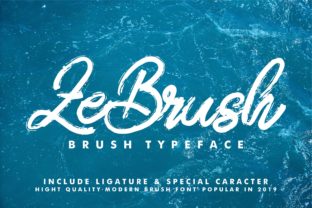
ZeBrush stands out not because it mimics handwriting perfectly—but because it strikes a deliberate, refined balance between organic gesture and intentional design. It’s a single-weight, connected script font built from real brush strokes, yet carefully edited for consistency, spacing, and legibility across sizes and contexts. Unlike many handwritten fonts that lean heavily into casual imperfection or decorative excess, ZeBrush maintains visual cohesion without sacrificing warmth. That makes it useful—not just stylistically pleasing—in real-world design work.
What Sets ZeBrush Apart From Other Script Fonts
Most script fonts fall into one of two categories: either tightly controlled calligraphic styles (often rigid or overly formal), or loose, irregular scripts better suited to social media graphics than professional branding. ZeBrush occupies the middle ground. Its letterforms retain subtle variation in stroke thickness and terminal flicks—evidence of its brush origin—but with measured rhythm and even baseline alignment. The connections between letters are natural, not forced; ascenders and descenders flow without colliding or crowding. This isn’t accidental. Each glyph was adjusted for optical balance, meaning “ZeBrush” looks stable whether set at 16px on a website header or 72pt on a product label.
It includes standard Latin characters, numerals, basic punctuation, and common diacritics—enough for English, Spanish, French, German, and Portuguese use in most cases. It does not include extended Cyrillic, Greek, or Asian language support, nor does it offer alternate glyphs or stylistic sets. That’s a limitation for global publishing, but a practical choice for its intended scope: focused, high-impact applications where clarity and tone matter more than linguistic breadth.
Where ZeBrush Delivers Real Value
ZeBrush works best where personality and professionalism intersect. Think brand identities for boutique studios, artisanal food packaging, editorial features in lifestyle magazines, or keynote slides for creative workshops. It’s especially effective when paired with clean, neutral sans-serifs like Inter, Lato, or Helvetica Neue—creating contrast without visual tension.
- Small business branding: A local ceramics studio used ZeBrush for its logo lockup and product tags. The font conveyed craft and care without looking dated or overly whimsical—key for appealing to both younger collectors and interior designers.
- Digital marketing: An online course platform applied ZeBrush sparingly in email subject lines and hero section subheads. Open rates improved modestly—not due to the font alone, but because it helped messages stand out in crowded inboxes while still feeling trustworthy.
- Educational materials: A literacy nonprofit used ZeBrush in illustrated vocabulary cards for upper elementary students. Teachers reported stronger engagement, likely because the font felt approachable but not childish—unlike many “handwriting” fonts designed for early learners.
Usability Considerations for Designers and Developers
ZeBrush is distributed as a desktop font (OTF) and includes webfont files (WOFF2) for modern browsers. Installation is straightforward, and it renders well in Figma, Adobe Creative Cloud, and Sketch. Kerning pairs are well-adjusted, though manual tweaks may be needed for specific combinations—“r” followed by “a”, for example, benefits from slight tracking adjustment at smaller sizes.
On screen, ZeBrush remains readable down to ~20px in headings and ~24px in body text—if used as a display face. It should not be used for long-form paragraphs, footnotes, or data tables. Its strength lies in short, high-visibility text: logos, quotes, invitations, slide titles, packaging copy, and app interface labels where tone matters as much as information.
For developers integrating ZeBrush into websites, WOFF2 loading is fast and lightweight (~45 KB). It performs reliably with @font-face declarations and respects system font fallbacks when properly declared. No JavaScript dependencies or external CDNs are required—important for teams prioritizing performance and privacy compliance.
Consistency and Long-Term Practicality
Unlike variable fonts or multi-style families, ZeBrush offers only one weight and no italic variant. That’s a constraint—but also a strength. It eliminates decision fatigue during layout and ensures typographic hierarchy stays clear. You won’t accidentally pair mismatched weights or struggle with inconsistent x-heights across variants. For teams maintaining brand guidelines, this simplicity reduces inconsistency risk over time.
Its design avoids trends that date quickly—no excessive swashes, no exaggerated bounce, no artificial ink bleeds. That contributes to longevity. A logo set in ZeBrush today is unlikely to feel out of place five years from now, assuming the broader brand strategy remains coherent. It’s not “timeless” in the way Garamond is—but it’s durable within its category.
Who Benefits Most—and When to Look Elsewhere
Freelance designers building identity systems for lifestyle, wellness, education, or creative service brands will find ZeBrush especially practical. So will small business owners handling their own marketing assets—or marketers collaborating closely with designers who need a reliable, expressive script that doesn’t require extensive customization.
It’s less suitable for technical documentation, enterprise SaaS interfaces, financial reporting, or multilingual publications requiring broad character coverage. If your project demands heavy text setting, tight vertical rhythm, or strict accessibility compliance for low-vision users (beyond standard contrast checks), ZeBrush shouldn’t serve as primary text. It’s a tool for emphasis—not infrastructure.
Also consider workflow fit. If your team relies on cloud-based design tools with limited font syncing, verify ZeBrush is available in your version of Figma or Canva Pro before committing to it across deliverables. While desktop use is seamless, some browser-based editors may not render its ligatures or spacing identically without local installation.
Final Assessment: Purposeful, Not Perfect
ZeBrush doesn’t try to be everything. It’s not a replacement for calligraphy, nor is it meant to replicate handwriting flawlessly. Instead, it functions as a considered typographic voice—one that brings human texture to digital and print environments without undermining clarity or credibility. Its value emerges most clearly when used intentionally: as a signature element rather than background noise.
In practice, that means reserving ZeBrush for moments where tone carries equal weight to content—like a founder’s quote on a homepage, a chapter title in an ebook, or the tagline on a conference badge. Used that way, it supports communication instead of competing with it. And that’s what separates a thoughtful type choice from mere decoration.
If you’ve tested other handwritten fonts only to find them too playful, too stiff, or too inconsistent across formats, ZeBrush warrants a closer look—not as a novelty, but as a quietly capable option for projects where authenticity and polish must coexist.