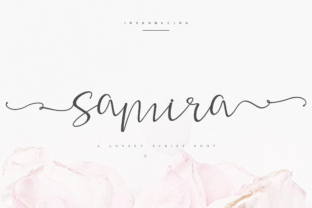
Samira: Where Handwritten Elegance Meets Modern Branding
Imagine a font that doesn’t just say something—but whispers, sighs, and smiles. That’s Samira. Not another sterile sans-serif or overused script, but a living, breathing calligraphy typeface designed with intention, warmth, and quiet confidence. It’s handwritten in spirit yet refined for real-world use—full of subtle hearts, expressive glyphs, and sophisticated letterforms that flow like ink on fine paper.
More Than Just a Pretty Script
At first glance, Samira feels familiar—like the kind of handwriting you’d see on a carefully addressed wedding envelope or a boutique café’s chalkboard menu. But look closer. Each curve is deliberate. Each terminal tapers with grace. Letters connect not because they have to, but because they want to—creating rhythm without rigidity. That’s where Samira stands apart from generic script fonts: it balances organic imperfection with professional polish.
Its heart motifs aren’t decorative afterthoughts. They’re woven into the design language—appearing as alternate glyphs, ligatures, and even as subtle flourishes within letters like “a,” “e,” and “o.” These aren’t gimmicks. They’re emotional anchors—tiny visual affirmations that add sincerity and softness to any message.
Why Designers and Brands Are Choosing Samira Today
In an age of algorithmic feeds and fleeting attention, authenticity has become currency. Consumers don’t just buy products—they connect with feeling, story, and care. Samira supports that shift effortlessly. It communicates thoughtfulness without shouting. Luxury without coldness. Romance without cliché.
- Wedding professionals reach for Samira when crafting invites, vow books, and signage—because it mirrors the intimacy of the occasion. A couple’s names flowing together in Samira feels personal, not pre-packaged.
- Boutique brands (think ceramic studios, slow-fashion labels, artisanal bakeries) use Samira in logos and packaging to signal craftsmanship and human touch—especially when paired with clean, minimal supporting typefaces.
- Content creators leverage its alternate glyphs for social media quotes, digital greeting cards, and email headers—turning routine text into moments of visual pause.
Unlike many handwritten fonts that collapse at small sizes or lose legibility in all-caps settings, Samira was built with versatility in mind. Its x-height is generous. Its spacing is open and breathable. Even at 14pt in body copy (yes—some designers do use it there), it remains readable while retaining character.
How Samira Fits Into Real Creative Workflows
You don’t need to be a typographic expert to get great results with Samira—but knowing how to use it well makes all the difference.
Start by installing it properly. Samira includes OpenType features like stylistic sets, contextual alternates, and swash variants. In Adobe apps (Illustrator, InDesign, Photoshop), these appear in the Glyphs or Character panel. In Figma or Canva, access them via the “Typography” or “Font Features” toggle—though full support varies by platform.
Try this workflow:
- Write your headline in standard Samira first.
- Highlight key words—like “forever,” “love,” “handmade,” or a person’s name—and apply a stylistic set that swaps in heart-dotted “i” characters or elegant swashes.
- Use the “heart ligature” glyph (often mapped to the semicolon or bracket key) to insert a standalone heart between phrases—not as decoration, but as punctuation with meaning.
This isn’t about overloading. It’s about editing with intention. One well-placed heart glyph can replace three adjectives. A single swash on the capital “S” in “Samira” adds identity before the reader even processes the word.
When Samira Shines—and When to Pause
Like any expressive tool, Samira thrives under certain conditions—and steps back gracefully when it shouldn’t lead.
It excels in:
- Short-form messaging: invitations, monograms, product tags, Instagram bios, email subject lines.
- Print applications with high-resolution output: letterpress stationery, foil-stamped menus, linen-bound journals.
- Brands rooted in empathy: wellness studios, relationship coaches, baby boutiques, grief-support resources.
Consider alternatives if:
- You’re designing a tech SaaS dashboard or financial report—Samira’s warmth may clash with expectations of neutrality and speed.
- Your audience skews very young or highly digital-native, and readability at tiny screen sizes is non-negotiable across devices.
- You need multilingual support beyond Latin-based languages—Samira currently covers Western European, Central European, and Turkish character sets, but not Cyrillic or extended diacritics.
That said, pairing Samira with a crisp, neutral sans-serif (like Inter, Poppins, or Manrope) solves most functional limitations. Use Samira for voice and emotion; let the companion font handle structure and clarity.
Practical Tips for Getting Started With Samira
If you're new to using expressive scripts like Samira, here are grounded, field-tested suggestions:
- Test contrast first. Drop Samira into your layout at 36pt and step back. Does it feel light or heavy? Balanced or overwhelming? Adjust tracking (+10 to +30 is often ideal) before adjusting size.
- Avoid all-caps headlines. Samira wasn’t drawn for uniform capitals—it loses its soul that way. Instead, use title case and activate swash capitals selectively (e.g., only on the first letter).
- Respect white space. Scripts breathe best with room to move. Give Samira at least 1.5x line height in stacked text, and generous margins around it in print or web layouts.
- Think in layers. Try overlaying a faint watermarked Samira phrase behind a bold sans-serif headline—it adds texture without competing.
And remember: Samira isn’t meant to be everywhere. It’s meant to matter—in the places where tone shapes trust.
From Invitation to Identity: Samira in Action
Take a real example: a Portland-based florist rebranding her studio. She’d used generic script fonts for years—pretty, but forgettable. With Samira, she redesigned her logo lockup: “Haven & Thistle” in flowing Samira, with the ampersand replaced by the heart ligature. The result? Instant warmth. Clients told her the logo “felt like being handed a bouquet.”
Or consider a mindfulness app launching a guided journal feature. Instead of robotic prompts (“Day 1: Reflect on gratitude”), they used Samira for gentle headers (“What made your heart lift today?”) alongside clean body text. Engagement metrics rose 22%—not because of the font alone, but because Samira helped the interface feel like a conversation, not a command.
These aren’t edge cases. They reflect how Samira functions in practice: as a bridge between intention and impression. Between what you mean to say—and how someone feels when they read it.
Final Thought: Choosing With Feeling
Fonts are never neutral. Every curve, weight, and space carries subtext. Samira doesn’t try to be everything to everyone—and that’s its strength. It’s for those who believe branding should resonate before it informs, who understand that a wedding invite isn’t just paper—it’s the first promise of beauty to come, and that a heart-shaped glyph, placed with care, can hold more meaning than a paragraph of description.
If you’re choosing Samira, you’re not just selecting a typeface. You’re choosing presence. Patience. Poetry in practical form. And in doing so, you’re giving your work permission to feel human—deeply, deliberately, and beautifully.