Cocktail Shaker: Where Whimsy Meets Typographic Intention
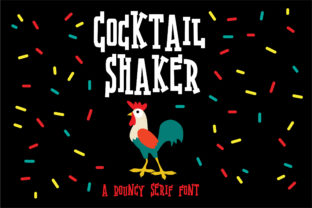
There’s a quiet shift happening in how we choose type—not just for logos or headlines, but for voice, tone, and emotional resonance. Cocktail Shaker arrives at that moment with unmistakable presence: a whimsical serif font whose bouncy baseline isn’t just decorative—it’s expressive, intentional, and quietly subversive. It doesn’t shout; it winks, leans in, and invites attention without demanding it. That’s rare in today’s typographic landscape, where many serifs lean either toward austere tradition or overly engineered neutrality. Cocktail Shaker occupies a thoughtful middle ground—rooted in serif heritage but animated by contemporary sensibility.
A Serif That Moves With You
Serif fonts have long carried connotations of authority, readability, and timelessness—think book typography, editorial layouts, or institutional branding. But as digital interfaces, social feeds, and personal websites multiply, users increasingly expect type to reflect personality, not just polish. Cocktail Shaker answers that need with its defining trait: a bouncy baseline. Letters don’t sit rigidly on a flat line; they gently rise and fall, like conversation catching rhythm—slight lifts on “n,” “m,” and “h,” subtle dips on “g” and “p.” This isn’t randomness. It’s carefully calibrated optical variation that mimics natural handwriting cadence, lending warmth without sacrificing structure.
That bounce does more than charm the eye. It subtly signals approachability—valuable for educators designing course materials, freelancers building client-facing portfolios, or small business owners crafting email newsletters. A restaurant owner selecting Cocktail Shaker for their seasonal menu isn’t just choosing aesthetics; they’re signaling hospitality, craft, and human-scale attention. Likewise, a sustainability blogger using it for article headings adds levity to serious topics—making climate action feel grounded, not grim.
Why Now? Context Over Convenience
Cocktail Shaker didn’t emerge in a vacuum. Its relevance is tied to broader shifts: the decline of one-size-fits-all branding, the rise of micro-audiences, and growing fatigue with algorithmically optimized sameness. Platforms once rewarded uniformity—clean, safe, scalable fonts that rendered predictably across devices. Today, audiences reward distinction. They notice when a newsletter subject line uses a serif with character instead of another sans-serif clone. They remember the boutique skincare brand whose packaging feels hand-touched, even when it’s digitally designed.
This isn’t about rejecting utility—it’s about expanding what utility means. A font must still perform: render clearly on mobile, support multilingual characters, pair well with functional sans-serifs for body text. Cocktail Shaker meets those needs while adding something harder to quantify: tonal precision. In an era where “brand voice” is often reduced to stock phrases and AI-generated captions, choosing a font like Cocktail Shaker becomes an early, low-effort act of authentic positioning.
Real-World Pairings That Work
Typography thrives in relationship—not isolation. Cocktail Shaker shines strongest when contrasted thoughtfully:
- With neutral sans-serifs like Inter, Lato, or Manrope for body copy—letting its personality anchor headings while keeping reading effortless.
- In editorial layouts where hierarchy matters: use it for pull quotes or section dividers, not dense paragraphs. Its rhythm rewards breathing room.
- In motion: subtle CSS animations (a gentle lift on hover, staggered letter fade-ins) amplify its bouncy baseline without feeling gimmicky—ideal for landing pages or portfolio hero sections.
- In print applications like limited-run zines or artisan product tags, where its tactile quality translates beautifully to ink-on-paper texture.
It’s less effective—and potentially distracting—in data-heavy dashboards, legal disclaimers, or multi-column academic journals. Knowing where it fits is part of using it well.
Beyond Aesthetics: What the Bounce Communicates
That bouncy baseline does psychological work. Research in perceptual psychology suggests slight irregularities in visual rhythm can increase engagement and memorability—our brains pause, orient, and assign meaning more readily to patterns that feel human-made rather than machine-perfect. Cocktail Shaker leverages that instinct. It doesn’t simulate imperfection; it embraces variation as a feature of intentionality.
For creators building personal brands—freelance designers, independent educators, indie game developers—this matters. Your website isn’t just a portfolio; it’s a first impression shaped in under two seconds. A font like Cocktail Shaker tells visitors, “This person pays attention to detail, values craft, and doesn’t mistake seriousness for stiffness.” That impression precedes any case study or bio paragraph.
Business owners also benefit from this nuance. Consider a local ceramics studio launching an online shop. Using a stiff, traditional serif might unintentionally evoke museum archives rather than handmade mugs. Cocktail Shaker, paired with warm photography and concise copy, bridges that gap—honoring material tradition while feeling alive and accessible.
Evolving With Practice, Not Just Trends
Cocktail Shaker reflects a larger evolution in font design philosophy: away from rigid classifications (“display” vs. “text”) and toward adaptive functionality. Modern web fonts are expected to be variable, responsive, and expressive—not just technically sound. Its OpenType features likely include stylistic alternates, ligatures, and contextual swashes—tools that let designers fine-tune expression without switching families.
But adoption isn’t automatic. Many professionals still default to system fonts or overused web-safe options—not out of preference, but because evaluating new type requires time, testing, and confidence in licensing. Cocktail Shaker’s accessibility helps here: it’s available through reputable foundries with clear licensing tiers (including web-only and desktop bundles), documentation on pairing and usage, and previews that show real text rendering—not just isolated glyphs.
What’s changed isn’t just availability—it’s expectation. Users now scroll past dozens of identical sans-serif headlines daily. Standing out doesn’t require loudness. It requires coherence: a font that supports your message, not competes with it. Cocktail Shaker succeeds because its whimsy serves purpose. Its bounce isn’t frivolous—it’s functional punctuation for the visual sentence.
Practical First Steps
If you’re considering integrating Cocktail Shaker into your next project, start small and intentional:
- Test it with your actual content, not placeholder text. Try it on a real headline, quote, or call-to-action—not just “The quick brown fox…”
- Compare rendering across devices. Does the bounce hold up on a 14-inch laptop versus a 6.7-inch phone? Adjust weight or size if needed—lighter weights often emphasize rhythm better than bold ones.
- Reserve it for moments of emphasis. One strong use per page or screen often resonates more than repeated application.
- Check contrast ratios if used for body text or small UI elements—whimsy shouldn’t compromise accessibility.
- Pair it with restraint. Let it breathe. White space, generous line height, and minimal decoration allow its character to land.
None of this requires expertise—just observation and willingness to treat type as part of your communication strategy, not just decoration.
Not a Trend, But a Tool With Temperament
Cocktail Shaker won’t replace Helvetica. It shouldn’t. Its value lies in specificity—not universality. It’s the right choice when you want elegance with energy, tradition with tilt, clarity with charm. That makes it especially useful for people who communicate regularly but aren’t professional designers: educators crafting slide decks, nonprofit staff writing donor updates, solopreneurs updating their Squarespace site, podcasters designing episode thumbnails.
What endures isn’t novelty—it’s resonance. And Cocktail Shaker resonates because it understands something fundamental: professionalism and playfulness aren’t opposites. They’re complementary frequencies in how humans connect, persuade, and remember. When your font carries that understanding in its baseline, every word carries a little more weight—and a little more joy.