Mariblock: A Serif Font That Adds Quiet Charm to Everyday Design
If you’ve ever stared at a blank presentation slide, refreshed your blog’s homepage for the tenth time, or hesitated before hitting “publish” on a newsletter—wondering why it feels just a little too stiff or generic—you’re not overthinking it. You’re sensing a gap between function and feeling. That’s where Mariblock steps in: a serif font with gentle personality, soft contrast, and that subtle, occasional underline—not as decoration, but as punctuation with purpose.
What Mariblock Actually Is (and Isn’t)
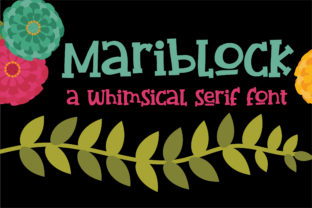
Mariblock isn’t a display font meant for giant billboards or a monospaced workhorse for coding. It’s a carefully drawn serif designed for readability *and* resonance—think of it as the kind of typeface you’d choose for a small-run poetry chapbook, a thoughtful email signature, or the “About Us” page of a ceramicist’s online shop. Its letterforms have warmth without fuss: slightly rounded terminals, open counters, and that signature underline—not on every word, but selectively, like a quiet nod to emphasis or rhythm.
It pairs naturally with its sans-serif sibling, Marigold. Where Mariblock brings texture and tradition, Marigold offers clean flexibility—ideal for captions, navigation menus, or data labels. Together, they form a cohesive voice: one that’s human-centered, not algorithm-optimized.
For Educators & Course Creators
A high school history teacher designing a handout on primary sources might use Mariblock for pull quotes or document excerpts. Why? Because its serif structure supports long-form reading—even on screen—and the underline helps students visually anchor key phrases (“the right to assemble,” “due process”) without bolding or color, which can distract from historical tone. It doesn’t scream “attention!”—it invites reflection.
For Small Business Owners & Local Makers
Imagine a Portland-based candle maker updating her product labels. She swaps a generic serif for Mariblock on her ingredient list and scent description. Suddenly, “soy wax, lavender essential oil, cedarwood absolute” feels less like a compliance footnote and more like part of the story. The underline appears only on “hand-poured” or “locally sourced”—small moments of authenticity that customers notice, even if they can’t name why.
For Bloggers & Newsletter Writers
You don’t need flashy fonts to build trust—but you do need consistency and care. Using Mariblock for body text in a Substack about sustainable gardening or indie publishing signals intention. Readers subconsciously register the attention to detail: the spacing, the rhythm, the way the underline gently underscores a line like “This method cuts water use by 40%.” No exclamation points required.
For Freelancers & Creatives Building Portfolios
A freelance illustrator’s website often lives or dies on first impression—not by how many projects are shown, but how cohesively they’re framed. Mariblock in headings and project descriptions adds narrative weight. When paired with Marigold for buttons and tags, the site feels curated, not cluttered. Clients scanning quickly still absorb tone: thoughtful, grounded, quietly confident.
When Mariblock Might Not Be the Right Fit
That same charm becomes a liability in certain contexts. Mariblock isn’t ideal for dense legal disclaimers, multilingual interfaces with complex scripts, or mobile-first forms where clarity trumps character. Its underline—while expressive—isn’t functional in UI elements like input fields or error messages. And if your brand voice is aggressively minimalist (think tech startups favoring ultra-thin sans-serifs), Mariblock’s warmth may feel tonally misaligned.
Also worth noting: Mariblock works best at medium to large sizes—16px and up for web body text, 24pt+ for print headlines. At tiny sizes or low-res screens, its subtleties blur. Test it where it’ll live, not just where it looks pretty in a font sampler.
Practical Tips Before You Use It
- Start small. Try Mariblock in one section of your next project—like a testimonial block or an email footer—before overhauling everything. See how it changes pacing and perception.
- Respect the underline. It’s not a replacement for semantic HTML (emphasis) or accessibility best practices. Use it sparingly, intentionally—never for links (that’s what is for).
- Pair with intention. Mariblock + Marigold is a natural duo, but it also holds its own with neutral sans-serifs like Inter or Lato. Avoid pairing it with overly decorative or high-contrast fonts—they compete instead of complement.
- Check licensing early. Mariblock is available under both personal and commercial licenses. If you’re using it in client work, a SaaS dashboard, or merchandise, verify the license covers your use case—no surprises at launch.
Why This Kind of Type Matters More Than You Think
We spend hours choosing logos, color palettes, and stock photos—but often default to system fonts or free Google Fonts for body text. Yet typography is the silent translator between your message and how it’s received. Mariblock doesn’t shout. It doesn’t trend-hop. It simply makes written language feel a little more considered—whether you’re writing a grant application, drafting a wedding invitation, or labeling jars for your farmers’ market stall.
That occasional underline? It’s not whimsy for whimsy’s sake. It’s a visual pause—a breath—that mirrors how people actually read and absorb information: not in blocks, but in meaningful fragments. In a world saturated with noise, Mariblock offers quiet confidence: the kind that comes from knowing your words deserve thoughtful framing.
So next time you’re refining a landing page, prepping a workshop handout, or finalizing a zine layout—pause before reaching for the default. Ask: Does this text need to be seen, or felt? If the answer leans toward “felt,” Mariblock might just be the quiet collaborator you didn’t know you were missing.