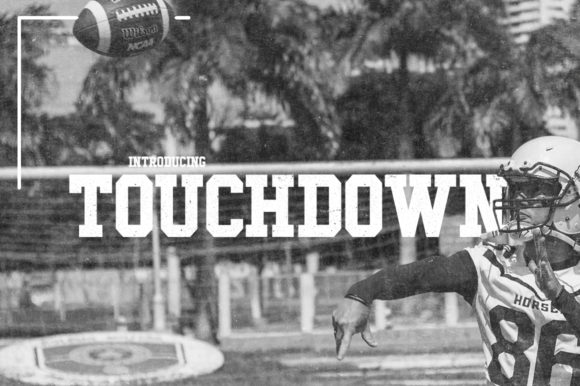
Touchdown: Where Sporty Energy Meets Vintage Charm
Imagine a font that doesn’t just say something—but leaps off the page. That’s Touchdown: a dynamic, sporty typeface with a subtle vintage twist that brings movement, personality, and unmistakable presence to any design. It’s not merely decorative; it’s communicative. Whether you’re launching a boutique fitness brand, designing a retro-inspired album cover, or refreshing your café’s seasonal menu board, Touchdown delivers impact without sacrificing authenticity.
More Than Just Bold Letters—A Design Attitude
Touchdown was crafted for moments that demand attention—not through noise, but through intention. Its letterforms combine crisp, athletic geometry (think sharp angles, confident curves, and rhythmic spacing) with gentle nods to mid-century signage and hand-painted sports banners. The uppercase “T” stands tall and grounded; the “O” carries a slight oval warmth; the “D” has a subtle flared terminal that hints at inked brushwork. These aren’t accidents—they’re thoughtful details that make Touchdown feel both energetic and human.
Unlike ultra-modern sans-serifs or ornate display fonts, Touchdown occupies a rare middle ground: bold enough for headlines and signage, expressive enough for storytelling, and legible enough to hold its own in short blocks of text—like event posters, product labels, or social media graphics.
Who Finds Value in Touchdown?
- Creatives & Designers: Looking for a go-to display font that adds character without requiring custom illustration.
- Small Business Owners: From juice bars to indie record shops, those who want branding that feels alive, local, and memorable.
- Content Creators: Podcasters, YouTubers, and newsletter writers using visuals to reinforce tone—especially in lifestyle, wellness, or culture-focused niches.
- Event Planners & Educators: For festival banners, workshop flyers, or school spirit materials where energy and approachability matter.
Real-World Uses That Shine
Here’s where Touchdown truly earns its name—not as background decoration, but as a functional design partner:
- Fitness Studio Branding: A yoga studio named “Summit Flow” used Touchdown for its logo and class schedule posters. The font’s upward motion echoed their “rise, stretch, grow” ethos—and customers consistently commented on how “inviting yet strong” it felt.
- Retro-Food Packaging: A small-batch soda brand revived 1950s flavor names (“Crimson Citrus,” “Midnight Mocha”) and paired them with Touchdown on glass bottle labels. The vintage nuance reinforced authenticity, while the sporty structure kept it from feeling kitschy.
- Music Festival Identity: Organizers chose Touchdown for stage signage and merch because it balanced festival energy with readability at distance—no squinting needed, even under afternoon sun.
- Classroom Visuals: A middle-school science teacher printed Touchdown-based vocabulary cards for her “Motion & Forces” unit. Students recalled terms faster—partly because the font itself looked like motion.
What Makes Touchdown Stand Out—Literally and Figuratively
Three qualities set Touchdown apart from similar display fonts:
- Optical Balance: Its x-height is generous, and stroke contrast is carefully tuned—so letters remain clear even at smaller sizes (down to ~24pt in print, ~32px on screen).
- Vintage Without Nostalgia Overload: No distressed textures, no forced “aged” effects. Instead, it uses proportion and rhythm to evoke era—making it adaptable across decades of design trends.
- Neutral Warmth: Unlike aggressively geometric fonts that can feel cold, Touchdown includes subtle organic inflections—softened corners, slight curve variations—that invite connection rather than command attention.
Practical Considerations Before You Commit
Like any strong personality, Touchdown thrives when matched thoughtfully—not universally. Here’s what to keep in mind:
It’s not a body-text workhorse. While highly legible in short bursts, Touchdown isn’t designed for long paragraphs or dense editorial layouts. Use it for headlines, callouts, logos, buttons, and visual anchors—then pair it with a clean, neutral sans-serif (like Inter, Open Sans, or Lato) for supporting text.
Color and contrast matter more. Because of its expressive forms, Touchdown performs best against simple, uncluttered backgrounds. On busy photos or textured surfaces, test legibility early—especially for accessibility compliance (WCAG AA minimum contrast ratios still apply).
Weight options are intentional—not exhaustive. Most versions include Regular, Bold, and sometimes an Outline or Shadow variant. That’s by design: Touchdown prioritizes clarity and cohesion over complexity. If your project demands ultra-light or black weights, consider whether another font might serve better—or use Touchdown selectively where its voice matters most.
Evaluating Fit for Your Project
Ask yourself these three questions before choosing Touchdown:
- Does this need to feel active, confident, or spirited? If your message leans into motion, celebration, growth, or community, Touchdown aligns naturally.
- Is recognition or memorability a priority? Logos, app icons, and storefront signs benefit from Touchdown’s distinctive silhouette—even at small scale.
- Will it coexist with other voices? Review your full typography system. Does Touchdown complement—or compete with—your existing fonts? A quick side-by-side mockup often reveals harmony (or friction) faster than theory.
Final Thought: Touchdown Isn’t Just a Font—It’s a First Impression With Momentum
In digital spaces crowded with sameness, Touchdown offers something increasingly rare: clarity with charisma. It doesn’t shout to be heard—it moves forward with purpose, inviting viewers to lean in, remember, and respond. That’s why designers return to it for rebrands, why teachers print it on classroom walls, and why founders choose it when they want their values to be visible before a single word is read.
You don’t need a massive budget or a design degree to harness its power. Start small: redesign one social post. Refresh a landing page headline. Print a single poster. Notice how the tone shifts—not just visually, but emotionally. That’s the quiet confidence of Touchdown: sporty enough to energize, vintage enough to resonate, and always, unmistakably, present.
For hands-on exploration, try Touchdown in free webfont previews or desktop trials—many found via trusted foundries or platforms like Google Fonts (where available) or independent type studios. Always verify licensing for commercial use, especially in apps, merchandise, or client work.