Madaram Font Family: Where Raw Energy Meets Refined Clarity
Typography is more than just letters on a screen or page—it’s the silent voice behind every message. It shapes perception, guides emotion, and reinforces identity. In today’s fast-moving digital landscape, where attention spans are short and authenticity is prized, font choices carry real weight. Enter Madaram: a contemporary font family that stands apart—not by chasing trends, but by balancing two seemingly opposite qualities: rough texture and clean precision. Whether you're designing a bold brand campaign, crafting a minimalist portfolio, or building an inclusive educational platform, Madaram offers expressive versatility grounded in thoughtful design.
What Is Madaram—and Why Does It Matter?
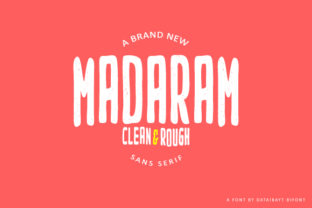
Madaram is a dual-style font family—comprising both Rough and Clean variants—that shares consistent proportions, x-heights, and structural DNA. Unlike many “hybrid” fonts stitched together from disparate sources, Madaram was conceived as a unified system: one family with two distinct personalities, designed to coexist seamlessly.
The Rough style features hand-drawn imperfections—slight variations in stroke width, subtle ink bleed effects, and organic terminals. It evokes immediacy, human touch, and creative spontaneity. Think of it as the sketchbook version of your idea—unpolished, alive, and full of potential.
The Clean style, by contrast, delivers crisp geometry, even spacing, and high legibility—even at small sizes or on low-resolution screens. Its refined curves and balanced rhythm make it ideal for body text, UI labels, data dashboards, and any context demanding clarity and trust.
Together, they form a rare typographic dialogue: not competition, but collaboration. That duality is what makes Madaram uniquely suited to modern communication—where brands must feel both authentic and professional, creative and accessible.
More Than Aesthetic: The Functional Power of Dual-Style Typography
At first glance, Madaram might appear to be about visual flair—but its true value lies in functionality through contrast. Consider these everyday applications:
- Brand Identity Systems: Use Madaram Rough for headlines, logos, or hero banners to convey energy and originality; pair it with Madaram Clean for subheadings, captions, or navigation menus to maintain readability and cohesion.
- Educational Platforms: In e-learning interfaces, Madaram Clean ensures students with dyslexia or visual impairments can scan content effortlessly, while Madaram Rough adds visual hierarchy and emotional resonance to key concepts or motivational quotes.
- Editorial Design: Magazines and digital newsletters benefit from Madaram’s tonal range—Rough for provocative pull quotes or section dividers; Clean for immersive long-form reading.
- Startup Websites: Early-stage companies often need to project both innovation (via Rough) and reliability (via Clean)—without switching between unrelated typefaces that dilute visual consistency.
This isn’t just stylistic convenience—it’s cognitive efficiency. Research in perceptual psychology shows that readers process information faster when typographic hierarchy is clear and intentional. Madaram streamlines that process by offering built-in contrast without sacrificing harmony.
Dispelling Common Misconceptions
Before diving deeper, let’s clarify three frequent assumptions about Madaram—and why they miss the point:
- “Rough means unprofessional.” Not at all. Roughness, when intentionally designed—as in Madaram—is a deliberate expressive tool. It signals approachability, creativity, and human-centered values—qualities increasingly valued in tech, healthcare, and education sectors.
- “You need design expertise to use Madaram well.” While typography benefits from intention, Madaram’s pairing logic is intuitive. Its shared metrics mean no awkward scaling or spacing fixes—just select Rough for emphasis, Clean for function, and trust the system.
- “It’s only for display or decorative use.” False. Madaram Clean has been tested across WCAG AA standards for contrast and readability. Its open counters, generous letter spacing, and robust hinting support accessibility in real-world apps—from government portals to fintech dashboards.
How Madaram Fits Into Today’s Creative & Technical Ecosystem
In an era defined by cross-platform experiences—mobile apps, responsive websites, digital signage, AR overlays—typography must be adaptive, not just attractive. Madaram answers that need with technical rigor:
- Variable Font Support: Available in variable format, Madaram allows smooth transitions between weights and optical sizes—ideal for dynamic interfaces that respond to user preference or device capability.
- OpenType Features: Includes stylistic alternates, ligatures, and case-sensitive forms—giving designers nuanced control without custom coding.
- Web-Optimized Delivery: Lightweight WOFF2 files and intelligent subsetting ensure fast load times, supporting Core Web Vitals and SEO best practices.
- Global Language Coverage: Supports Latin, Cyrillic, Greek, and extended Latin-1 characters—making it viable for international brands and multilingual learning tools.
For developers, Madaram integrates cleanly via CSS @font-face or popular CDNs. For educators, it’s compatible with Google Slides, Canva, and Figma—democratizing professional typography across disciplines.
Motivation Beyond the Screen: Why Madaram Inspires
There’s something quietly empowering about using a font that refuses to choose between grit and grace. In a world saturated with algorithmically smoothed visuals and homogenized aesthetics, Madaram reminds us that clarity doesn’t require sterility, and authenticity doesn’t demand chaos.
Students experimenting with their first branding project discover confidence when their typography feels both personal and polished. Small business owners launching a website realize they don’t need a $5,000 design retainer to communicate credibility and charm. UX writers find new ways to soften technical language—using Madaram Rough for empathetic microcopy (“We’re here to help”), and Clean for actionable instructions (“Click ‘Save Changes’ to confirm”).
Even beyond design, Madaram reflects broader cultural shifts: toward hybrid identities, inclusive expression, and systems that honor complexity without overwhelming simplicity. It’s typography that doesn’t ask you to pick a side—it invites you to hold both truths at once.
Getting Started With Madaram: Practical Next Steps
Ready to explore? Here’s how to begin—no jargon, no gatekeeping:
- Try the free web version on platforms like Google Fonts or the official Madaram foundry site—many offer trial weights for non-commercial use.
- Test contrast and legibility using browser dev tools: zoom to 200%, switch to grayscale, and check if text remains distinguishable—especially important for accessibility compliance.
- Start small: Replace just one heading or button font with Madaram Rough, then follow with Clean for supporting text. Observe how tone shifts—and how users respond.
- Document your choices: Note why you picked Rough vs. Clean in each context. Over time, this builds a living typographic guide—valuable for teams, clients, and future projects.
Remember: great typography isn’t about perfection. It’s about purposeful alignment—between message and medium, audience and intent, craft and compassion. Madaram doesn’t promise to solve every design challenge. But it does offer a thoughtful, flexible, and deeply human foundation to build upon.
Whether you’re shaping a startup’s first landing page, designing curriculum materials for underserved learners, or simply choosing a font for your personal blog—Madaram invites you to embrace nuance, trust contrast, and communicate with both heart and clarity. And in doing so, it becomes more than a typeface. It becomes a quiet act of intention in a noisy world.