Conian: A Clean, Modern Sans Serif Rooted in Sign Painting Tradition
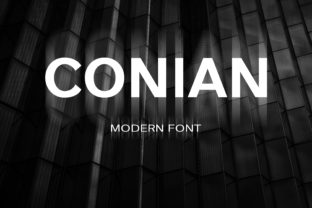
If you’ve ever admired the crisp lettering on a hand-painted café awning or the quiet confidence of a boutique storefront sign—where every curve feels intentional and every space breathes—you’ll recognize the spirit behind Conian. It’s not just another sans serif. Conian is a carefully considered typeface inspired by traditional sign painting techniques, distilled into something lean, legible, and unmistakably contemporary. Think of it as the quiet voice in your design that doesn’t shout—but still commands attention.
Where Conian Fits Naturally (Without Trying)
Conian thrives where clarity meets character. It’s not built for dense body text in long-form reports, nor does it chase trend-driven extremes like ultra-thin weights or exaggerated geometric quirks. Instead, it settles comfortably into places where people need to read quickly, trust easily, and feel a subtle sense of care—like a well-designed business card, a thoughtful newsletter header, or the “About” section of a freelance portfolio site.
Take Maya, a yoga instructor launching her first online course. She spent hours choosing fonts for her landing page—wanting warmth but also professionalism. She tried three overly friendly scripts (too casual), two rigid tech fonts (too cold), then landed on Conian. Its open counters and even rhythm made her headlines easy to scan on mobile, while its slight calligraphic lift—especially in the uppercase ‘C’, ‘S’, and ‘R’—gave her brand a grounded, human touch. No extra explanation needed. Just clean, confident presence.
Real Uses Across Real Roles
Conian works because it adapts—not by changing shape, but by holding space well. Here’s how different people use it without overthinking:
- Freelancers & small business owners: Use Conian for logos, social media banners, and printed menus. Its balanced x-height and generous spacing mean it stays readable at small sizes—on a takeaway cup label or a tiny Instagram story sticker. One web designer told us she uses Conian exclusively for client project titles in her case studies; clients consistently say it “feels like the work itself—clear, intentional, no wasted motion.”
- Educators & course creators: Slides, handouts, and digital worksheets benefit from Conian’s neutrality. Unlike many minimalist fonts that blur together at a glance, Conian’s distinct letterforms (notice the angled cut on the lowercase ‘t’ or the soft termination on the ‘a’) help students visually anchor key terms. A high school art teacher uses it for slide headers and student name tags—“It doesn’t distract, but it also doesn’t disappear.”
- Bloggers & content creators: Pair Conian with a warm, highly readable serif for body text (like Merriweather or EB Garamond), and you get an immediate visual hierarchy that feels editorial, not algorithmic. Its light and regular weights hold up beautifully in email subject lines or blog post titles—even when rendered on older Android devices or Outlook desktop clients.
- Hobbyists & makers: Whether you’re designing a sticker for your ceramic studio, labeling jars for a homemade spice blend, or printing a zine about urban gardening, Conian adds polish without pretension. Its design respects craft—it nods to hand-lettering tradition without mimicking it—and that resonates with audiences who value authenticity over gloss.
What Makes It Work Where Other Fonts Don’t
It’s not just about looks. Conian’s usefulness comes from deliberate decisions baked into its structure:
- Optical consistency across sizes: The font family includes thoughtfully tuned weights—not just bold and light, but a true semi-bold and a nuanced medium—that scale cleanly from 14px captions to 96px hero text. No awkward thinning or bloating as size changes.
- Subtle rhythm, not rigid geometry: While many modern sans serifs enforce strict uniformity (same stem width, same curve radius), Conian allows gentle variation—thicker verticals, slightly flared terminals—echoing how a sign painter’s brush naturally responds to pressure and direction. That variation creates visual comfort, especially in longer headlines or short blocks of centered text.
- Language-ready, not just English-first: Conian supports Latin Extended-A, including accented characters used across French, Spanish, Portuguese, Polish, and Turkish. If your audience spans borders—or your small bakery names a croissant “Pistachio-Rosemary” with proper accents—you won’t hit rendering gaps or fallback fonts mid-sentence.
Before You Download or License Conian
Like any tool, Conian shines brightest when matched to the job—not forced into roles it wasn’t shaped for. Ask yourself these practical questions:
- Is legibility at smaller sizes critical? If you’re designing app UI labels, dashboard metrics, or tiny product tags, test Conian at 12–14px before committing. Its clean forms hold up better than most, but extremely tight spaces may call for a more engineered screen font.
- Do you need extensive language support? Conian covers Western and Central European languages well—but doesn’t include Cyrillic, Greek, or Arabic. If your project serves multilingual audiences beyond Latin-script regions, check compatibility early.
- How much typographic flexibility do you actually need? Conian offers five weights (Thin to Bold) and matching italics—but no variable axis or stylistic sets. If your workflow depends on fine-grained optical adjustments (e.g., shifting contrast or width on the fly), you might pair it with a variable font for body text instead of trying to stretch Conian too far.
- Where will it live? Conian is available as desktop, web, and app-licensed files. If you’re embedding it in a client’s WordPress site or SaaS dashboard, confirm licensing covers your intended use—especially if users will generate custom content with it.
And one last note: Conian isn’t meant to be “the only font you’ll ever need.” It’s the one you reach for when you want calm authority, when you’re choosing typography not to impress, but to serve—whether that’s helping a parent quickly find the right workshop time on a community center flyer, guiding a visitor through a museum exhibit label, or giving your podcast episode title the quiet weight it deserves.
It’s the kind of typeface that fades into the background—until someone pauses and thinks, “This feels right.” That’s the sign painter’s legacy, reimagined: skill, restraint, and respect for the person reading.