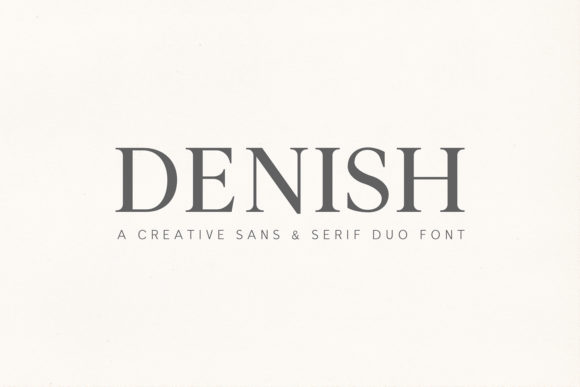
Denish: A Sophisticated Serif & Sans Serif Duo
Denish isn’t just another font pair—it’s a thoughtfully balanced typographic system where elegance meets clarity. One half is a refined serif, rich in character and quiet authority; the other, a clean, contemporary sans serif that breathes space and modernity. Together, they share consistent proportions, rhythm, and optical harmony—so they work seamlessly side by side or independently. Whether you’re setting body text for a newsletter, designing a book cover, or building a brand identity, Denish offers visual cohesion without compromise.
Why Typographic Harmony Matters—Differently for Different People
Typography shapes how people read, feel, and trust your message. But what “works well” depends heavily on who’s using it—and why.
For Beginners and Hobbyists
If you're just starting with design tools like Canva, Figma, or Google Docs, Denish lowers the barrier to professional-looking results. You don’t need deep knowledge of kerning or x-heights to notice how naturally its serif and sans serif complement each other in headings and paragraphs. Try pairing the serif for a blog title and the sans for subheads—it instantly adds polish without requiring custom adjustments. Its generous spacing and clear letterforms also reduce readability fatigue, making it forgiving for those still learning visual hierarchy.
For Educators and Content Creators
Teachers building lesson slides, course handouts, or digital worksheets often juggle legibility, accessibility, and visual appeal. Denish supports this balance: its serif version has open counters and strong stroke contrast—ideal for printed reading materials—while its sans counterpart maintains clarity at smaller sizes on screens. One educator used Denish to redesign her science unit handouts; students reported fewer eye strain complaints, and colleagues noticed improved visual flow during peer review sessions.
For Freelancers and Small Business Owners
When you wear multiple hats—designer, marketer, client communicator—consistency saves time and builds credibility. Denish lets you unify your brand voice across business cards, social posts, and email signatures using one coordinated family. A local bakery owner switched from mixing three unrelated fonts to Denish for her menu, website, and Instagram captions. The result? Customers began describing her branding as “calm but memorable”—a subtle shift rooted in typographic reliability, not expensive rebranding.
For Writers, Bloggers, and Publishers
Long-form content lives or dies by readability. Denish’s serif was designed with generous ascenders and descenders, soft serifs, and even ink traps—details that help printed text hold up under varied paper stocks and screen resolutions. Its sans serif counterpart doesn’t compete; instead, it provides a natural transition for pull quotes, captions, or callout boxes. A memoirist chose Denish for her self-published book because test readers found the serif comfortable over 200+ pages—and the sans gave chapter titles quiet distinction without shouting.
For Marketers and Brand Strategists
You know that moment when a font quietly signals “we’re thoughtful, not trendy”? Denish does that. It avoids the overused neutrality of generic sans serifs while staying far from decorative extremes. That makes it ideal for brands aiming for sophistication without pretension—think sustainable apparel labels, boutique consulting firms, or indie publishing houses. Unlike fonts built for maximum versatility (and minimal personality), Denish carries quiet confidence. It doesn’t distract—but it also doesn’t disappear.
What to Consider Before You Use Denish
Not every font fits every goal—even beautiful ones. Here’s how to check alignment:
- Ease of use: Denish includes OpenType features like ligatures and alternate numerals, but they’re optional. You can start with basic weights and add complexity only when needed.
- Cost and licensing: It’s available under flexible licenses—including web, desktop, and app use—so small teams and solo creators can scale usage without surprise fees.
- Flexibility: While Denish excels in editorial and branding contexts, it’s less suited for ultra-narrow UI buttons or high-contrast data dashboards where extreme legibility at tiny sizes is non-negotiable.
- Creative fit: If your project leans into bold, experimental typography—like glitch art or kinetic type—Denish may feel too grounded. But if your aim is clarity, warmth, and quiet distinction, it delivers consistently.
Real Projects, Real Decisions
A freelance illustrator used Denish to typeset her portfolio site—not for headlines, but for image captions. She wanted text that supported, not competed with, her watercolor illustrations. Denish’s serif offered gentle presence; its sans provided crisp contrast for technical notes about mediums and dimensions.
A university department redesigned its internal training modules. They needed a typeface that felt inclusive—not coldly corporate nor overly casual. Denish passed their accessibility audit (AA contrast compliance) and tested well with screen readers. More importantly, faculty feedback highlighted how the pairing helped distinguish procedural steps (sans) from conceptual explanations (serif)—a subtle but effective cognitive aid.
A podcast host launching a companion newsletter chose Denish for its email templates. She didn’t want something that screamed “designed,” but she also didn’t want default system fonts. Denish gave her tone: approachable, considered, and quietly confident—just like her show’s voice.
Is Denish Right for Your Next Project?
Ask yourself:
- Do you value visual consistency across print and digital formats?
- Are you balancing aesthetics with real-world readability—especially for longer texts or diverse audiences?
- Do you prefer a typeface that supports intention rather than demanding attention?
- Is your workflow streamlined by having one harmonized serif/sans pair instead of hunting for compatible fonts?
If more than two answers are yes, Denish is likely a practical match—not just a stylistic choice. It won’t solve every design challenge, but it removes friction where typography often adds it: in pairing, scaling, and maintaining tone across touchpoints.
And that’s the quiet strength of Denish: it gives you room to focus on meaning, not mechanics.