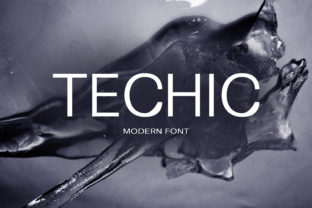
Techic: A Modern Sans Serif Font Built for Clarity and Character
Techic is a contemporary sans serif typeface designed with intention—not just for legibility, but for presence. It avoids the neutrality of many system fonts while resisting the overt stylization of display faces. The result is a font that feels both grounded and forward-looking: clean enough for interface text, expressive enough for headlines, and consistent enough to support extended reading.
What Sets Techic Apart Visually and Functionally
Techic’s distinctiveness lies in its balanced tension between geometric discipline and humanist warmth. Its letterforms follow a rational structure—uniform stroke contrast, open apertures, and generous x-height—but subtle variations in terminal shapes, curve modulation, and spacing introduce quiet rhythm. For example, the lowercase a and g use single-story forms that enhance readability at small sizes, while the uppercase M and W feature slightly tapered stems that prevent visual heaviness in all-caps settings.
Unlike many modern sans serifs optimized solely for screen rendering, Techic includes a full set of OpenType features—small caps, stylistic alternates, case-sensitive punctuation, and true fractions—that support typographic refinement without requiring design expertise. Its optical sizing variants (Text and Display) adjust weight distribution and spacing automatically based on intended use, reducing manual fine-tuning.
Where Techic Fits Among Contemporary Sans Serifs
When evaluating options, it helps to consider where Techic sits relative to common categories. It’s not a neutral utility font like Helvetica or Inter—those prioritize universality over voice. Nor is it a high-contrast, expressive sans like Neuzeit Grotesk or Klim’s Founders Grotesk, which lean into personality at the expense of versatility.
Instead, Techic occupies a middle ground: more distinctive than workhorse system fonts, yet more restrained than editorial-focused display faces. This makes it especially effective in contexts demanding both clarity and cohesion—product dashboards where labels and data points coexist, brand guidelines needing one typeface across UI, marketing assets, and documentation, or editorial sites balancing long-form articles with interactive elements.
Strengths That Support Real-World Use
Techic excels where consistency, scalability, and tonal nuance matter:
- Responsive environments: Its Text variant renders cleanly down to 12px on high-DPI screens, while the Display version maintains elegance in large-scale applications like hero banners or signage mockups.
- Cross-platform legibility: Designed with variable hinting and glyph optimization, Techic avoids the blurriness or uneven spacing sometimes seen with web-optimized fonts on older Android or legacy Windows systems.
- Brand alignment without overstatement: Because it conveys modernity without relying on trend-driven quirks (like exaggerated terminals or forced asymmetry), Techic supports brand evolution over time—it won’t feel dated in three years simply because a design fad has passed.
Practical examples illustrate this fit: a SaaS company using Techic for its dashboard interface reported improved user scanning speed during usability tests—particularly in dense data tables—while maintaining visual harmony with its marketing site’s blog and case studies. Similarly, an independent publisher adopted Techic across print and digital editions; designers noted reduced need for manual kerning adjustments and fewer requests for “lighter” or “bolder” weights from editors.
Tradeoffs and Situations Where Techic May Not Be the Best Fit
No font solves every problem—and Techic’s strengths come with natural boundaries. Its design prioritizes clarity and proportion over extreme expressiveness. If your project requires strong emotional signaling—such as urgency in a crisis alert system, playfulness in a children’s app, or tradition in a heritage institution’s identity—Techic may lack the tonal range needed without significant supporting design effort.
It also assumes a baseline level of typographic awareness. While it includes robust OpenType features, leveraging them effectively (e.g., enabling case-sensitive punctuation in headings or substituting small caps for acronyms) requires either developer configuration or design tool familiarity. Teams relying entirely on WYSIWYG editors with limited font-feature support may not access its full capabilities without additional setup.
Additionally, Techic is not a variable font. While its optical sizing variants cover most use cases, teams needing real-time weight or width interpolation—say, for dynamic UI scaling or experimental motion typography—will find more flexibility in variable alternatives. That doesn’t make Techic outdated; it reflects a deliberate choice to optimize for stability and predictability over technical novelty.
Comparing Practical Alternatives Based on Need
Choosing among sans serif options isn’t about finding the “best” font—it’s about matching characteristics to constraints and goals. Here’s how Techic compares in key decision areas:
- For accessibility-first interfaces: Techic meets WCAG AA contrast standards at standard sizes and supports clear character differentiation (e.g., 1, l, and I). However, if your team needs built-in language-specific localization (e.g., extensive Cyrillic or Vietnamese support beyond basic coverage), some open-source alternatives offer broader script expansion out of the box.
- For tight development timelines: Techic’s straightforward CSS implementation and minimal dependency requirements reduce integration friction. In contrast, fonts requiring complex loading strategies or fallback chains may add testing overhead—even if technically superior in theory.
- For budget-conscious projects: Techic is licensed per use case (web, desktop, app), with transparent tiered pricing. That contrasts with subscription-based models where cost scales with pageviews or users—a factor worth modeling if traffic fluctuates significantly.
When to Choose Techic—and When to Look Further
Techic is especially well-suited when you value:
- A single, cohesive typeface that performs reliably across multiple touchpoints—UI, documentation, presentations, and marketing—without requiring multiple families or constant stylistic negotiation.
- Design efficiency: predictable metrics, intuitive OpenType behavior, and minimal need for overrides or custom spacing rules.
- A tone that’s contemporary but not trendy—modern enough to signal competence and attention to detail, but neutral enough to avoid distracting from content or functionality.
Conversely, consider alternatives if:
- Your audience includes users with specific low-vision needs that require highly specialized letterform adaptations (e.g., dyslexia-friendly glyphs), and those are non-negotiable.
- You’re building a highly experimental or kinetic interface where variable axis control (weight, width, slant) is essential to the interaction model.
- Your project mandates open licensing for redistribution or modification—Techic’s license permits embedding and use but not derivative creation or resale of the font files themselves.
Ultimately, Techic stands out not by being the most feature-rich or the most widely recognized, but by delivering thoughtful consistency. It’s the kind of typeface that fades into the background when appropriate—yet earns quiet appreciation when noticed. That balance is rare. And for many teams weighing long-term maintainability against immediate impact, it’s exactly the kind of reliability worth building on.