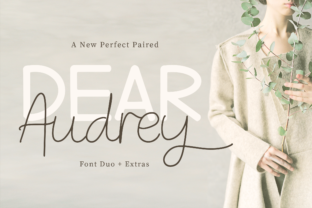
Dear Audrey: Elegant Handwritten Font Duo
Dear Audrey isn’t just another script font—it’s a thoughtfully paired duo: one style leans softly into cursive charm, the other offers clean, grounded letterforms that balance and complement. Together, they create visual harmony without sacrificing personality. Whether you’re designing a wedding invitation, branding a small-batch candle shop, or crafting a heartfelt classroom handout, Dear Audrey brings warmth and intentionality to the page.
Why this pairing stands out
Most handwritten fonts work well alone—but few are designed as intentional pairs. Dear Audrey’s two styles share consistent x-heights, spacing logic, and stroke weight relationships. That means headings in the flowing script version sit naturally above body text set in its more legible, slightly structured counterpart—no awkward resizing, kerning guesswork, or visual dissonance. It’s subtle, but it matters: readers absorb information faster when typographic hierarchy feels intuitive, not engineered.
How different people experience Dear Audrey
What makes Dear Audrey useful—or even essential—depends heavily on who’s holding the cursor (or pen) and why.
For beginners exploring design
If you’ve just opened Canva or started learning Adobe Express, Dear Audrey lowers the barrier to polished typography. You don’t need to understand optical alignment or baseline shifts to get good results. Try using the script for a title like “Welcome to Our Studio” and the supporting style for bullet points underneath—no adjustments needed. It works right away, which builds confidence fast.
For educators and presenters
Teachers often choose fonts based on readability *and* tone. A warm, humanist script like Dear Audrey’s primary style helps soften formal content—say, a welcome slide for parent-teacher conferences or a gentle reminder note posted in the hallway. Pair it with the secondary style for instructions or vocabulary lists. Students notice the care in the presentation, and that quiet attention to detail can reinforce trust and engagement.
For small business owners and solopreneurs
You’re likely juggling branding, marketing, and fulfillment—all without a dedicated designer. Dear Audrey gives you consistency across touchpoints: the same pair can anchor your Instagram story highlight icon, appear in your email newsletter signature, and define your packaging label. Because both styles scale cleanly and render reliably across devices, you avoid the frustration of fonts that look perfect on desktop but blur or thin out on mobile.
For freelance designers and marketers
You value flexibility—not just aesthetics. Dear Audrey includes OpenType features like contextual alternates and ligatures, so the script feels alive and natural, not robotic. When you’re delivering brand guidelines to a client, having two coordinated, high-quality fonts (rather than mixing unrelated scripts and sans-serifs) saves time explaining typographic rationale—and strengthens your credibility. Clients see cohesion; you gain efficiency.
For hobbyists and crafters
If you design greeting cards, stitch embroidery patterns, or make printable planners, Dear Audrey adds quiet sophistication without complexity. Its generous spacing and clear letterforms translate beautifully to cutting machines and print-on-demand services. One user shared how she used the script for “Happy Birthday” on a laser-cut wood sign and the supporting style for the date and name—both cut cleanly in one pass because the strokes weren’t overly delicate or tightly spaced.
What matters most—depending on your goals
Not every priority applies to every person. Here’s how key considerations play out:
- Ease of use: Beginners appreciate that Dear Audrey works well “out of the box.” No need to master advanced font management—just install and apply.
- Quality & reliability: Designers and developers care about hinting, cross-platform rendering, and file integrity. Dear Audrey is built with robust outlines and tested across operating systems and browsers.
- Creativity & expression: Artists and writers respond to how the script invites rhythm and variation—especially in longer quotes or poetic layouts where letterforms breathe and connect.
- Commercial value: For those licensing work or selling digital products, Dear Audrey’s license permits commercial use—including resale in templates—as long as the font files themselves aren’t redistributed.
- Long-term usefulness: Unlike trend-driven fonts that feel dated in 12 months, Dear Audrey draws from timeless calligraphic principles. It supports projects today—and still feels appropriate five years from now.
When Dear Audrey fits—and when it might not
It shines in contexts where warmth, humanity, and clarity coexist: personal branding, artisanal goods, educational materials, lifestyle blogs, boutique packaging, and heartfelt communications.
It’s less ideal if you need ultra-narrow widths for tight UI labels, require extensive language support beyond Latin-based scripts, or prioritize maximalist contrast (like pairing bold grotesques with ornate scripts). And while it’s highly legible at medium sizes, extended paragraphs in the script style alone would strain readability—so lean on the duo structure as intended.
A few real-world examples
- A yoga instructor uses Dear Audrey to design her seasonal workshop flyer: script for “Breathe Deeply,” supporting style for dates, location, and registration details.
- A freelance copywriter includes both Dear Audrey styles in her pitch deck—script for section headers (“Your Story, Told Well”), supporting style for case study summaries—giving clients a tactile sense of her voice before reading a word.
- A homeschool parent prints weekly learning menus with Dear Audrey: script for subject names (“Math Adventure”), supporting style for activities and time estimates—making routine feel inviting, not rigid.
- An indie publisher selects Dear Audrey for the cover of a memoir about childhood letters—its authenticity echoes the handwritten letters featured inside, reinforcing theme without explanation.
None of these uses demand technical mastery. What they share is intention: choosing a font not just for how it looks, but for how it supports meaning, mood, and message.
If you value typography that feels both considered and effortless—if your work bridges emotion and information—Dear Audrey offers more than decoration. It’s a quiet collaborator, helping your words land with sincerity and grace.