Lionelo Duo Font Pair: A Practical Evaluation for Designers
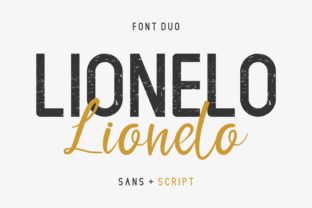
Lionelo Duo is a coordinated font pair consisting of an authentic script typeface and a complementary sans serif. Designed to work together, the two fonts share consistent proportions, spacing behavior, and visual rhythm—making them a cohesive typographic system rather than two independent typefaces used in proximity.
Unlike generic font combinations assembled manually, Lionelo Duo was developed with intentional optical alignment: the script’s x-height matches the sans serif’s, its stroke contrast harmonizes with the sans’s weight distribution, and its terminals and exits are calibrated to transition smoothly into the geometric clarity of the companion sans. This level of integration reduces manual tuning during layout and improves typographic consistency across headings, subheads, and body text.
Why Designers Consider Lionelo Duo
Designers often seek type systems that support both expressive voice and functional readability. A script font alone may lack legibility at small sizes or in extended text; a standalone sans serif may feel too neutral for branding or editorial emphasis. Lionelo Duo addresses this tension by offering a ready-made pairing where personality and practicality coexist.
Common use cases include logo design with taglines, wedding stationery, boutique packaging, editorial features, and digital landing pages where visual hierarchy matters. In each case, the script provides character—ideal for headlines, names, or short quotes—while the sans serif delivers structure and clarity for supporting text, captions, or interface elements.
Key Benefits of Using Lionelo Duo
- Time efficiency: Eliminates trial-and-error testing of script–sans combinations, especially for designers without deep typography training.
- Visual cohesion: Shared metrics—including baseline alignment, cap height, and letterfit—reduce inconsistencies when scaling or kerning across formats.
- Consistent tone: The pairing avoids stylistic dissonance (e.g., a highly decorative script with a rigid neo-grotesque), supporting unified brand expression.
- Cross-platform reliability: Both fonts are available in standard OpenType formats with full language support for Western European languages, making them suitable for web and print workflows.
Realistic Tradeoffs and Limitations
No font system excels in every context—and Lionelo Duo is no exception. Its script component, while elegant and natural-looking, is not intended for long-form reading. It lacks true italics, small caps, or extensive figure sets (e.g., old-style numerals or tabular figures), which limits its utility in data-heavy or typographically complex documents.
The sans serif is deliberately restrained—not minimalist, but moderate in contrast and character. It performs well in UI components and short labels but may lack the distinctiveness needed for high-contrast branding systems where uniqueness is prioritized over harmony.
Additionally, Lionelo Duo does not include variable font axes. Users requiring fine-grained control over weight, width, or optical size must rely on discrete font files, which can increase file load in web projects if all weights are loaded unnecessarily.
Situations Where Lionelo Duo Is a Strong Fit
Lionelo Duo works especially well when the project calls for balanced expressiveness and clarity within constrained design parameters. For example:
- A local café rebranding needs a warm, hand-crafted logo (script) paired with clean menu typography (sans)—without hiring a type designer to custom-tune spacing.
- An online magazine uses short, evocative article titles (script) alongside tightly set body copy (sans), prioritizing fast layout iteration over experimental typography.
- A small business owner building a Shopify store selects Lionelo Duo to maintain visual continuity across product cards, banners, and email headers—using only two fonts instead of three or four unrelated families.
In these scenarios, Lionelo Duo reduces decision fatigue and supports consistent execution, especially for non-specialist designers or teams with limited typography resources.
When Alternatives May Be More Appropriate
Consider alternatives if your project requires:
- Extended multilingual support: Lionelo Duo covers basic Latin-based languages but does not extend to Cyrillic, Greek, or Vietnamese. Projects targeting broader regions may need fonts like Recursive or Source Sans Pro with expanded language coverage.
- Highly technical typography: Documents requiring footnote styling, complex tables, or mathematical notation benefit from fonts with dedicated OpenType features (e.g., IBM Plex or Roboto). Lionelo Duo lacks advanced typographic controls for such tasks.
- Brand differentiation through contrast: If your identity thrives on juxtaposition—say, a sharp monospace with a flowing brush script—Lionelo Duo’s harmony may feel too unified. In those cases, intentionally mismatched pairs (e.g., Playfair Display + Inter) offer more deliberate visual tension.
- Web performance constraints: For sites where every kilobyte counts, lighter-weight alternatives like Fontsource-hosted system fonts or variable fonts with subsetting may deliver faster rendering than loading two full desktop-optimized families.
Making an Informed Choice
Evaluating Lionelo Duo isn’t about whether it’s “good” or “bad”—it’s about fit. Ask yourself:
- Does my project prioritize speed and consistency over maximal typographic flexibility?
- Will the script be used primarily for short, prominent text—and the sans for everything else?
- Do I need advanced OpenType features, broad language support, or variable axes—or is core Latin coverage and standard weights sufficient?
- Is visual harmony between display and functional type more valuable than stylistic contrast in this context?
If most answers trend toward “yes,” Lionelo Duo is likely aligned with your goals. If not, exploring modular systems—like pairing a single versatile sans with a carefully tested script—or investing time in custom font pairing may yield better long-term results.
Ultimately, Lionelo Duo serves as a thoughtful starting point—not a final destination. It lowers the barrier to professional-grade typography without oversimplifying the craft. For designers balancing creative intent with practical delivery, that balance itself is a meaningful advantage.